
Published November 20, 2026. Offers mentioned below are current as of this date; check the service coupons page for terms and expiration dates.
The first real snow in Canton usually shows up in the next few weeks, and the stretch between now and then is the best time of year to find out what shape your brakes are in. Pads and rotors that feel fine on dry pavement in October get asked to do a lot more on a slushy Ford Road in December. This guide covers when brakes need attention, why waiting costs more, what changes about braking in rain and snow, and how we walk you through Ford's Motorcraft® and Omnicraft™ options at Quick Lane at Atchinson Ford in Belleville, about 10 minutes from the center of Canton.
When do brakes need to be done?
There is no single mileage for brake pads. On the same vehicle, a highway commuter might see 60,000 miles from a set and a stop-and-go driver might see 25,000. What matters is the measurement, so the honest answer is: have them measured, then plan from the number.
- Every oil change. The Works® package includes a brake inspection with the oil change and tire rotation, which is why most of our customers never get surprised by their brakes. The technician measures pad thickness and looks at the rotors while the wheels are already off for the rotation.
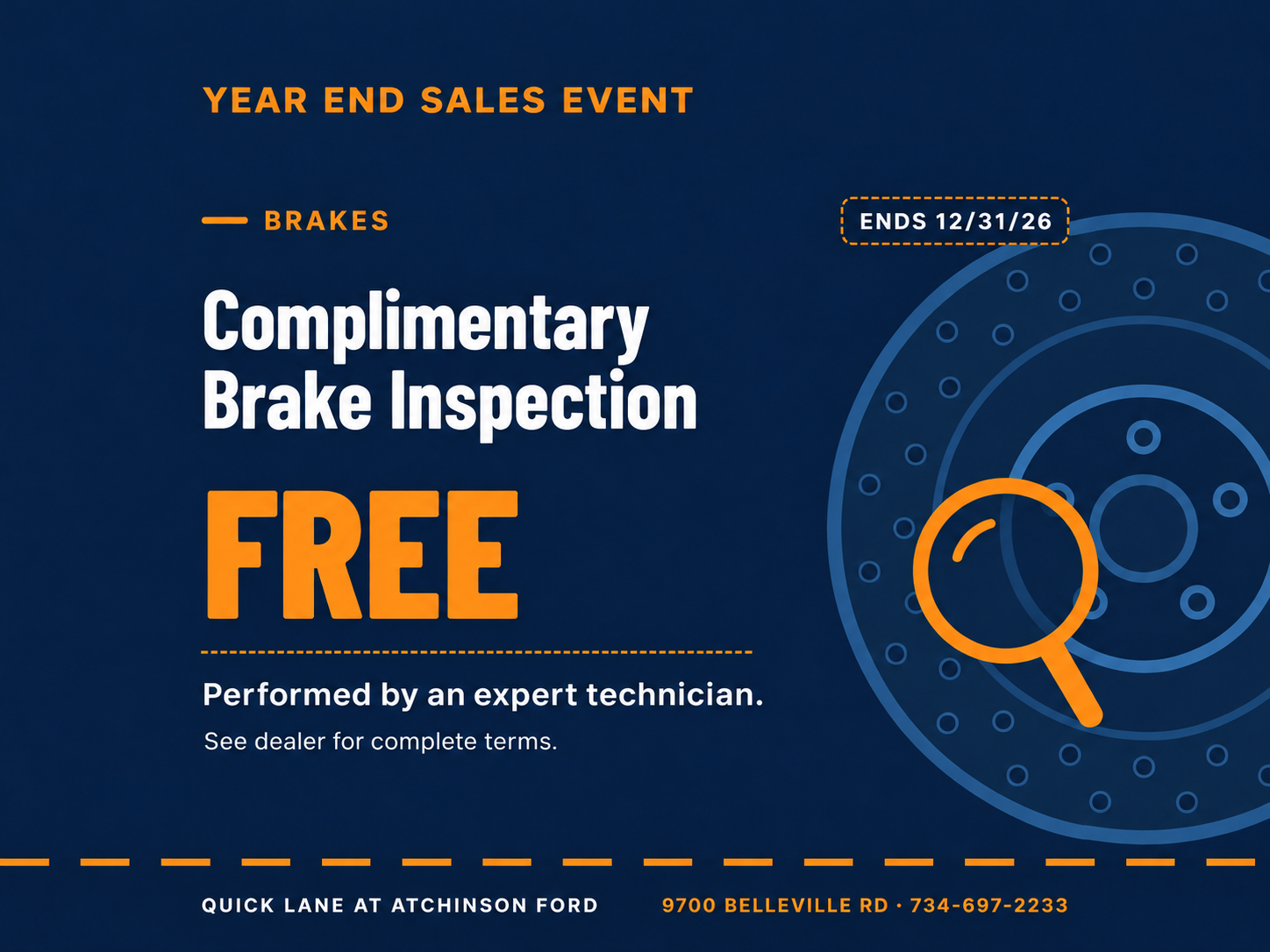
- Before winter and before a long trip. Even if the last inspection was recent, a quick check before the weather turns is cheap insurance; through December 31, 2026 the brake inspection at Quick Lane is complimentary.
- Any time you notice a change. Noise, a different pedal feel, a pull or a warning light should be checked right away rather than at the next scheduled visit.
As a rule of thumb, pads are usually recommended for replacement around 3 millimeters of friction material, and many shops will flag them at 4 millimeters so you can plan the visit instead of being forced into it. Rotors have a minimum thickness stamped on them; once they are at or below it, they have to be replaced rather than resurfaced.
The warning signs
- Squealing when you brake. Most pads have a wear indicator that makes a high-pitched squeal when the material is nearly gone. It is designed to be annoying.
- Grinding. Metal-on-metal. The pad backing plate is now cutting into the rotor, and what would have been a pad job is turning into a pad-and-rotor job.
- A pulsing pedal or a shake in the steering wheel while braking. Usually uneven rotor wear or rotor thickness variation.
- Pulling to one side. Often a sticking caliper or a collapsed brake hose, both common on vehicles that spend winters in road salt.
- A soft, low or spongy pedal. Air or moisture in the brake fluid, or a leak. This one is urgent.
- A brake or ABS warning light, or a burning smell after driving.
If you can tell us when it happens (cold mornings, highway speeds, light braking, hard braking), the diagnosis goes faster.
Why you should not wait
Safety first. In NHTSA's National Motor Vehicle Crash Causation Survey, brake-related problems accounted for about 22 percent of the crashes where the vehicle itself was the critical reason. Brakes that are worn, glazed or uneven do not fail all at once; they just stop a little later and a little less evenly each month, until the day you need every foot.
It costs less early. A set of pads replaced on time is the least expensive brake job there is. Pads that are run to the backing plate take the rotors with them, and a seized caliper from a neglected winter can add a caliper and a hose. The complimentary inspection is how you stay on the inexpensive side of that line.
Fuel economy and tire life. A caliper that does not fully release drags the pad on the rotor all the time. You pay for that in fuel, in heat, and in a tire that wears faster on one corner. It is a common finding on vehicles that have been through a few salty winters.
Resale and trade-in value. A documented brake service in the history is one of the first things an appraiser looks for, because it is one of the first things a buyer will notice on a test drive. If you are thinking about a trade this winter or next spring, the service record helps.
Why brakes matter more once the weather turns
Dry pavement forgives a lot. A tired set of brakes can feel acceptable in September because the tires have plenty of grip to work with and stopping distances are short. Rain and snow take that margin away.
- Rain. Wet roads lengthen stopping distances, and the first rain after a dry spell lifts oil off the pavement. Brakes that pull or pulse are hard to modulate on a wet surface, which is exactly when smooth, even braking matters most.
- Snow and ice. On a slick surface, your anti-lock brakes are doing dozens of tiny applications per second. They need even pad contact, healthy rotors and clean fluid to do that well. A caliper that sticks or a rotor that is warped makes ABS work harder and stop later.
- Cold. Brake fluid absorbs moisture over time. In cold weather that moisture can affect pedal feel, and under hard braking it lowers the fluid's boiling point. Ford publishes a brake fluid service interval for each model; the advisor can look yours up.
- Salt. Michigan road salt is hard on rotors, caliper slide pins and brake lines. Surface rust on a rotor after a wet night is normal and wipes off in the first few stops; pitting, grooves and a lip at the edge of the rotor are not.
Canton driving is a mix of stop-and-go on Ford Road and Michigan Avenue and highway miles on I-275 and M-14. That combination heats brakes up and cools them down constantly, which is why a pre-winter inspection is worth more here than in a place with one kind of driving.
Good, better, best: the brake options we walk you through
Every brake job at Quick Lane starts the same way: the technician measures the pads and rotors, checks the calipers, hoses and parking brake, and gives you the findings and an estimate before any work is done. From there, you choose the parts. Here is how we explain the choices.
Good: Omnicraft™ brake pads
Omnicraft is Ford's parts line for all makes and models, so it is often the right call if you drive something other than a Ford, or if you want a quality part at a lower price point. Omnicraft pads come in ceramic and semi-metallic formulations and are backed by a warranty of at least two years that covers parts and labor. Quick Lane services all makes, so this is the option that keeps a Honda, Chevy or Toyota in the family on the same schedule as the Ford.
Better: Motorcraft® brake pads
Motorcraft is Ford's own service brand, engineered for Ford and Lincoln vehicles. Motorcraft pads are built to match the original equipment design and friction material, with chamfered and slotted pads to reduce noise and heat, and the insulators, shims and hardware in the box so the job is done right the first time. They carry Ford's two-year, unlimited-mile Motorcraft warranty, which includes labor. And when a Ford dealer or Quick Lane technician installs them, they qualify for Ford's Lifetime Brake Pad Guarantee: replacement pads for as long as you own the vehicle (pads only; labor and any other brake service are extra, and you need your original repair order). For most Ford owners this is the sweet spot.
Best: Motorcraft® pads with Motorcraft coated rotors
If the inspection shows the rotors are at or near their minimum, or they are grooved, pitted or warped, the best long-term job is pads and rotors together. Motorcraft coated rotors use a high-carbon casting that resists heat cracking and brake fade, are mill-balanced for vibration-free stops, and have an anti-corrosive coating on the hat and vents. That coating matters in Michigan: it keeps the vents from rusting shut and keeps the rotor from corroding onto the hub. New pads bedded onto new, true rotors is the quietest and smoothest brake job we can do, and it resets the clock on everything. (Mustang, Bronco and Raptor owners who want more than stock can also ask about Ford Performance brake components.)
Whichever tier you pick, the inspection is free through December 31, 2026, and all Motorcraft and Ford parts installed here are covered for two years with unlimited mileage, including labor.
What is on offer right now
- Complimentary Brake Inspection through December 31, 2026: friction material, caliper operation, rotors, drums, hoses, connections and parking brake.
- Lifetime Brake Pad Guarantee on Motorcraft pads installed by a Ford dealer or Quick Lane technician.
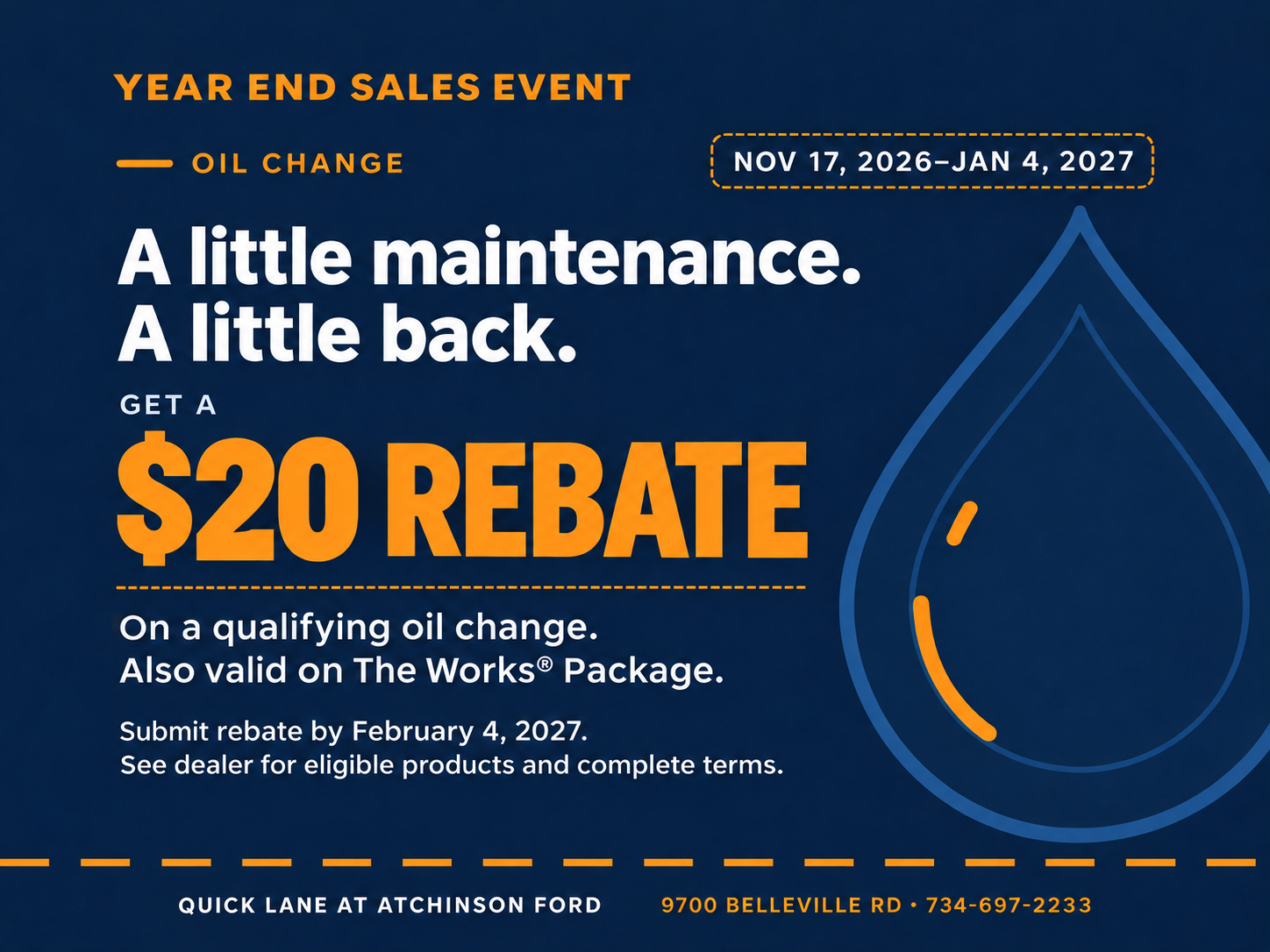
- The Works® synthetic blend oil change package starts at $89.95 through December 31 and includes a brake inspection and tire rotation, plus Ford's $20 rebate or 5,000 Ford Rewards Points on the oil change through January 4, 2027.
- Ford Rewards. Brake service earns points you can put toward the next visit.
- Service Now, Pay Later. If a pad-and-rotor job lands at a bad time, ask about Quick Lane financing.
Full terms are on the service coupons page and the Quick Lane specials page.
How to get it done from Canton
- Book online or call Quick Lane at 734-697-2233. Tell us the year, make, model and mileage and what you have noticed.
- Drive down Canton Center Road; it becomes Belleville Road at Michigan Avenue. Quick Lane is at 9700 Belleville Road, next to the dealership, about 10 minutes from the center of Canton. From I-275, use the Ecorse Road exit.
- Get the inspection results and an estimate, choose the parts, and we do the work. Pair it with The Works if an oil change is due so the rotation and inspection happen in one visit.
Our brake service near Canton page has the details and the FAQ, our brake service advice page explains what the common noises mean, and the Quick Lane brakes page covers the full menu. For a Ford warning light or a complex repair, the main Atchinson Ford Service Center is at 9800 Belleville Road.
Questions we hear every November
How long does a brake job take? An inspection is usually done while you wait. Pads on one axle are typically a same-day job; pads and rotors on both axles depend on parts availability. Call ahead and we will give you a realistic time.
Do I need new rotors with new pads? Not always. Rotors are measured during the inspection. If they are above minimum thickness and smooth, they can stay; if they are scored, warped or below minimum, they should be resurfaced or replaced with the pads.
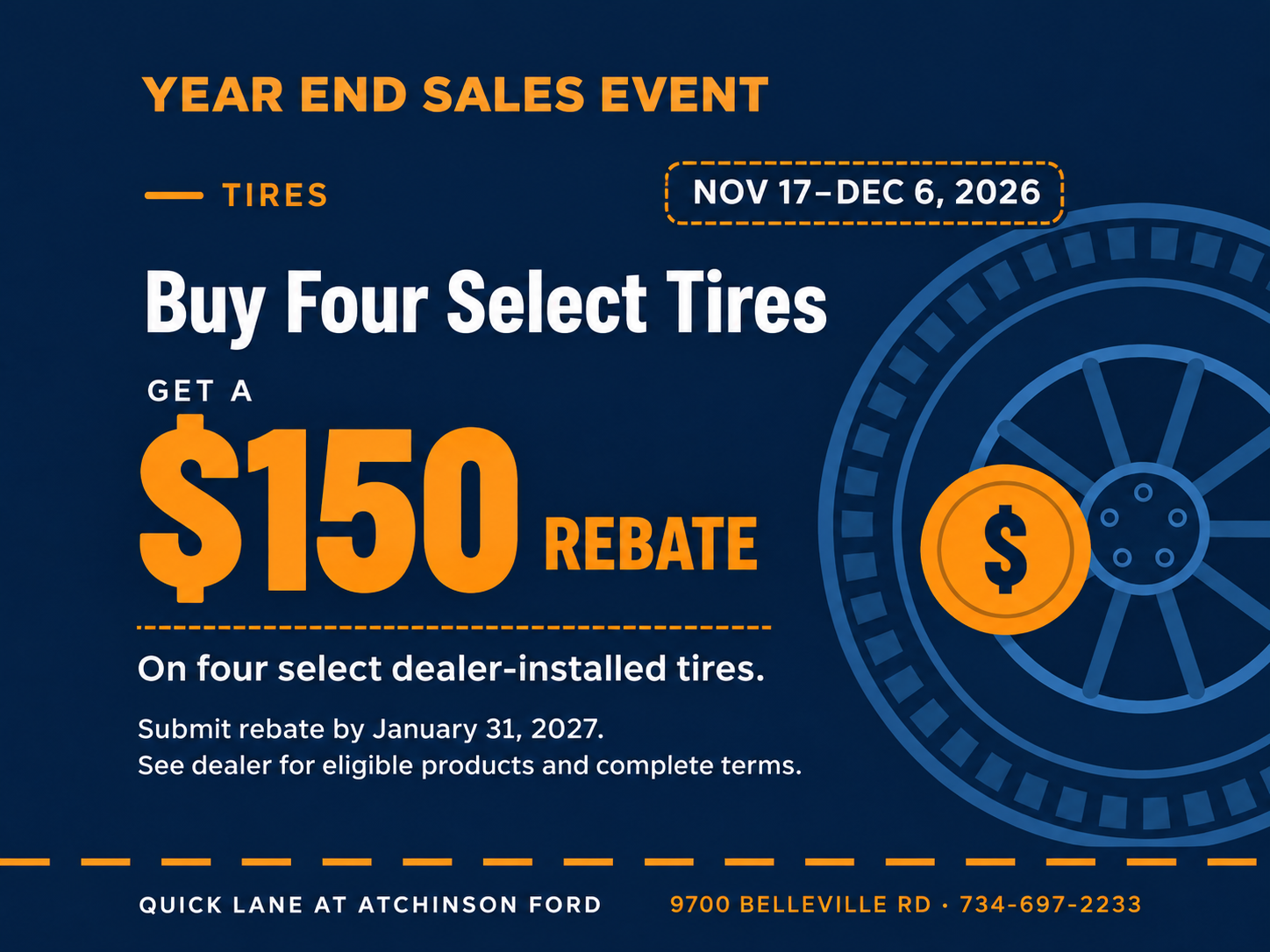
Should I do brakes or tires first before winter? Both matter, and they work together: your tires provide the grip and your brakes use it. If you can only do one right now, let the inspection decide; a set of pads at 2 millimeters is more urgent than tires at 5/32", and the reverse is also true. Our tires near Canton page covers the current $150 rebate, which runs through December 6.
Is the lifetime guarantee really lifetime? Yes, for as long as you own the vehicle, on Motorcraft pads installed by a Ford dealer, Lincoln dealer or Quick Lane technician. It covers the pads only; labor and any other brake service, such as rotors, are extra, and it requires the original repair order. Commercial, police, taxi and similar vehicles are excluded.
You service non-Ford vehicles? Yes. Quick Lane services all makes and models, and Omnicraft parts are made for exactly that.
Complimentary Brake Inspection and Lifetime Brake Pad Guarantee per the coupon terms; see participating dealer for details. Lifetime Brake Pad Guarantee available for Motorcraft® brake pads purchased after 7/1/14; nontransferable; requires copy of original repair order and completion of any necessary brake service (e.g., rotor service); pads must be installed by a U.S. Ford Dealer, Lincoln Dealer or Quick Lane® technician; covers pads only, labor costs excluded; commercial, taxi, limousine, postal, police, tow, racing and emergency vehicles excluded. Motorcraft® and Ford Parts warranty: two years, unlimited mileage, includes limited labor; see dealer for a copy of the limited warranty. The Works® package includes up to six quarts of Motorcraft® oil and Motorcraft oil filter; excludes hybrid battery test. Ford may change or discontinue these programs at any time. Quick Lane®, Motorcraft®, Omnicraft™ and The Works® are trademarks of Ford Motor Company. Crash statistic: NHTSA, Critical Reasons for Crashes Investigated in the National Motor Vehicle Crash Causation Survey (DOT HS 812 506).