Blog / 2026 Mustang

The 2026 Ford Mustang Dark Horse®: A Purpose-Built Pony Car with Serious Street Credentials 

Mustang logo badge - The 2026 Ford Mustang Dark Horse®: A Purpose-Built Pony Car with Serious Street Credentials 
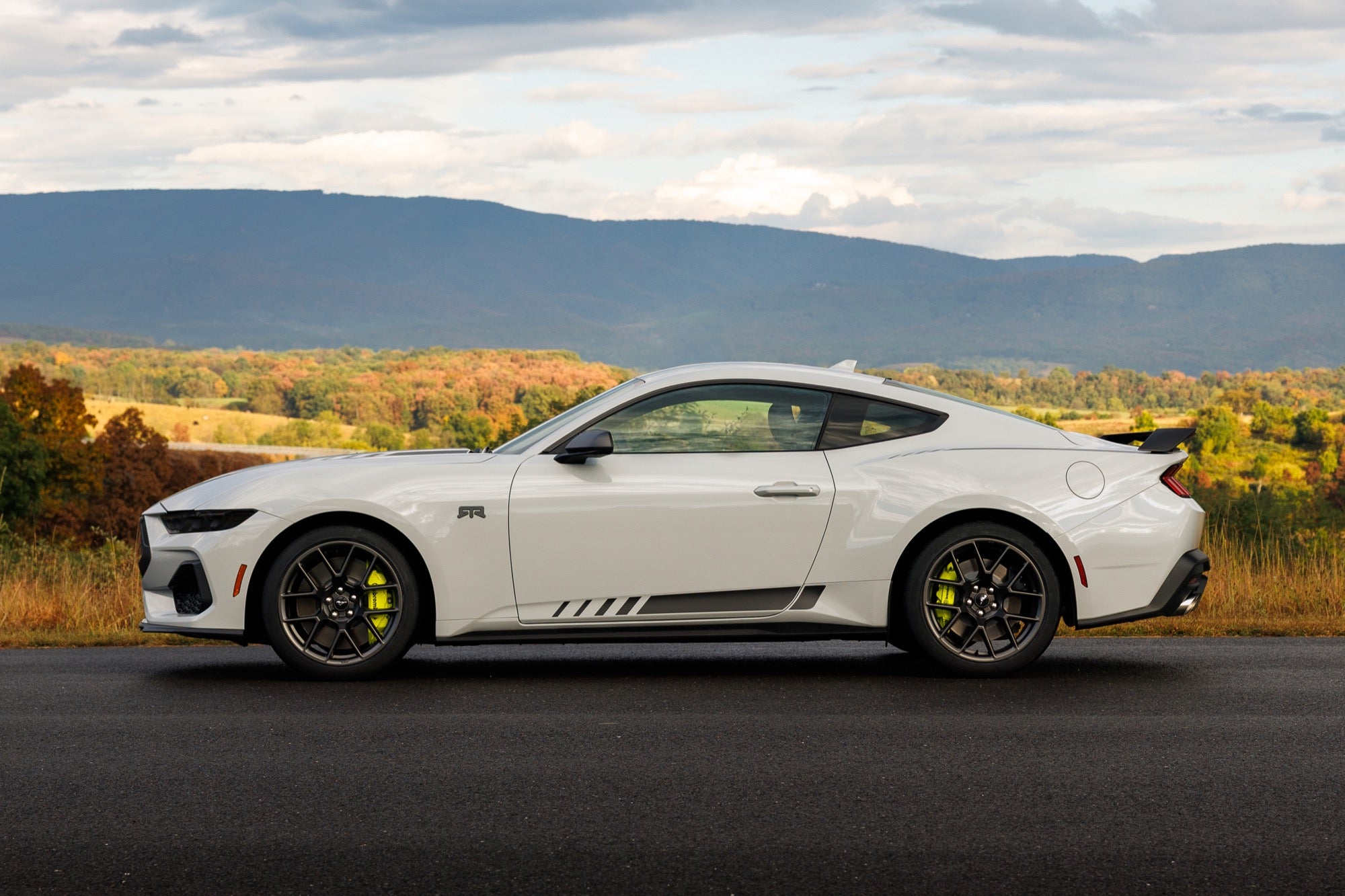
If you've been watching the 2026 Ford Mustang lineup, the Mustang Dark Horse® stands apart from the rest. It's not just a trim level—it's a focused, performance-first package built for drivers who want more than a great-looking car. From its modified engine to its standard MagneRide® Damping System, the Mustang Dark Horse® exhilarates from the moment you start it up. The enthusiasts and thrill-seekers of Belleville, Michigan, awaits to take your breath away.   
  
What Powers the Mustang Dark Horse®  
  
The Mustang Dark Horse® is powered by a modified 5.0L Coyote® V8 engine that produces an astounding 500 hp and 418 lbs.-ft. of torque. That's a serious step up from the standard Mustang GT's V8, which checks in at 480 hp. Ford's engineers didn't just bump the output - they revised the internals to deliver a more focused, track-ready experience at every RPM.  
  
The Mustang Dark Horse® comes standard with a TREMEC® 6-speed manual transmission featuring rev matching, so gear changes feel smooth and precise. A 10-speed automatic with SelectShift® capability and steering-wheel-mounted paddle shifters is also available for drivers who prefer it.  
  
Suspension and Braking You Can Feel in Your Bones 
  
Unlike the standard Mustang GT, the Mustang Dark Horse® includes the MagneRide® Damping System as standard equipment. This system reads the road 1,000 times per second and adjusts each damper accordingly, keeping the car planted whether you're on a smooth highway or a rough backroad.  
  
The Brembo® brake system with performance linings is also standard, giving you the stopping confidence to match that 500-hp output. The Class-First Drift Brake adds another heart-pumping elements, applying the brakes to the rear wheels only for controlled drifts on the track.  
  
What's Inside the Mustang Dark Horse®  
  
The Mustang Dark Horse® lures you in with a driver-centric, performance-first interior design. The magnesium-framed panoramic curved display brings together a 12.4” LCD digital cluster and a 13.2” LCD capacitive touchscreen under one expansive piece of glass. You can customize cluster themes and ambient lighting to suit your preferences.  
  
The exclusive titanium-anodized blue gear shift knob is unique to this model, and the Dark Horse® IP badge with a unique chassis number gives the interior a sense of identity you won't find elsewhere in the 2026 Ford Mustang lineup. Available RECARO® seats offer high-bolster support during aggressive driving, while heated front seats and a heated steering wheel add everyday comfort. The Premier Trim with Color Accent Group is available here as well, adding stitched accents throughout the cabin.  
  
New Seat Belt Colors and Interior Themes  
  
The 2026 model year adds new seat belt color options across the Mustang lineup, and the Dark Horse® gets its own. Joining Race Red, buyers can now choose Black with Red Stripe, International Orange, or Prime Blue. Two interior themes are exclusive to this model—Black and Blue, and Black Blue Dinamica—both of which use blue stitching on a Black Onyx base for a look that's understated but distinctive.  
  
Packages That Take the Mustang Dark Horse® Further  
   
For drivers who want even sharper cornering capability, the available Dark Horse® Handling Package adds wider Tarnished Dark aluminum wheels, factory-installed adjustable strut top mounts, a performance front aero splitter, and a performance rear spoiler with a Shadow Black gurney flap. The chassis tuning is revised specifically for this package, resulting in noticeably flatter cornering behavior.  
  
The Dark Horse® Appearance Package amplifies the car’s dramatic presence with a black-painted roof, exclusive Blue Ember Metallic paint, Notorious Blue brake calipers, and a distinctive hood graphic. It's a strong way to personalize the 2026 Ford Mustang Dark Horse® while keeping the aggressive aesthetic intact.  
  
Dark Horse® Premium Adds More Refinement  
  
The Dark Horse® Premium trim indulges you with heated and cooled front seats, an exclusive Titanium Anodized Blue gear shift knob, and the available Handling Package. It also opens up the Blue Ember Metallic paint option and
RECARO seats with contrasting accents - a compelling combination for drivers who spend time at the track but want a more complete daily experience.  
  
Why Drivers Choose the Mustang Dark Horse®  
  
The Mustang Dark Horse® attracts drivers who appreciate the difference between a performance-oriented package and a genuinely track-focused build. It comes standard with equipment that is optional on other trims—MagneRide® dampers, Brembo® brakes, and the Drift Brake among them. The modified engine, exclusive interior details, and available handling upgrades create a vehicle that feels like it was built with a clear purpose.  
  
For anyone in Belleville, MI, who’s been weighing the right 2026 Ford Mustang configuration, the Dark Horse® represents a serious step up in capability without sacrificing everyday usability. Stop by Atchinson Ford to explore current inventory or
schedule a test drive online.
Posted in:

Related Posts

2026 Ford Mustang EcoBoost Premium Fastback: Your Daily Driver Sports Car in Southeast Michigan

2026 Ford Mustang EcoBoost Premium Fastback: Your Daily Driver Sports Car in Southeast Michigan

This content was aggregated from local dealer data and insights provided by the USA Today Network Automotive Insights team using Google Gemini and the Vehicles for Sale Near Detroit – Free Press Edition marketplace writing team. For sports-car enthusiasts in Belleville, Michigan, and the broader Detroit market, the 2026 Ford Mustang EcoBoost Premium Fastback offers a compelling blend of exhilarating performance and practical daily usability. This isn't just a vehicle for weekend joyrides; it's a sophisticated coupe designed to make every drive, from the morning commute to a spirited evening cruise, an engaging experience. At Atchinson Ford in Belleville, we understand that drivers want a vehicle that excites without compromising on the demands of everyday life. Turbocharged Performance for Everyday Roads The heart of the 2026 Ford Mustang EcoBoost Premium Fastback is its verified 2.3L EcoBoost engine, a powerplant meticulously engineered to deliver responsive performance in real-world driving conditions. With 315 horsepower at 5000 RPM, this 4-cylinder turbocharged engine provides ample thrust precisely when you need it. Paired with a smooth 10-Speed Automatic transmission, the power delivery is seamless and immediate. Pulling away from a stoplight in Belleville or merging onto a busy highway in Detroit feels confident and effortless. The EcoBoost engine's torque comes on strong at lower RPMs, meaning you don't have to rev the engine excessively to feel a surge of acceleration. This characteristic is particularly beneficial for navigating city traffic or making quick passes on routes through Wayne County. The 10-Speed Automatic transmission is a key player here, expertly managing gear changes to keep the engine in its optimal power band, ensuring responsiveness whether you're accelerating from a standstill or dropping a gear for an overtake. Agile Handling and Confident Driving Character Beyond its potent engine, the 2026 Ford Mustang EcoBoost distinguishes itself with a driving character that truly embodies the spirit of a sports car, even during routine trips. Its rear-wheel-drive (RWD) configuration is fundamental to this feel, providing a traditional sports-car dynamic that enthusiasts appreciate. The steering is precise and communicative, translating road feel directly to the driver's hands, making every turn, whether on a winding road near Ann Arbor or a straight stretch in Canton, engaging. The Mustang chassis is engineered for agility and stability. It strikes a balance between providing a firm, connected feel to the road and offering enough compliance for comfortable daily driving. This means you can enjoy spirited driving on recreational routes without feeling overly jostled on less-than-perfect city streets. The overall driving experience is one of control and confidence, allowing drivers in Southeast Michigan to truly connect with the road. Comfort and Practicality for the Daily Commute While undoubtedly a sports car, the 2026 Ford Mustang EcoBoost is also surprisingly accommodating for daily use. The front cabin prioritizes driver and passenger comfort, featuring options like ActiveX Bucket Seats or Leather-Trimmed Bucket Seats with Color Accents. For enhanced comfort, Climate Controlled Heated/cooled Front Seats are available, ensuring pleasant conditions regardless of the weather. A Driver Seat Memory with 3 Settings adds convenience for multiple drivers. Visibility from the driver's seat is generally good for a coupe, aided by thoughtful design. While trunk space is naturally more limited than a sedan, it offers enough room for groceries, a weekend bag, or everyday essentials. The rear seats, typical for a coupe, are best suited for occasional use or extra cargo. However, the cabin is well-appointed with modern technology, including SYNC 4 with AppLink, Apple CarPlay, and Android Auto smart device wireless mirroring, ensuring seamless connectivity. A Magnesium Framed Panoramic Curved Display enhances the modern feel, and available One-Year Connected Navigation, HD Radio, and SiriusXM with 360L keep you informed and entertained on drives through Ypsilanti or across the region. For commuting in traffic, the 2.3L EcoBoost engine and 10-Speed Automatic transmission work harmoniously. The transmission's many gears allow it to smoothly shift and maintain efficiency in stop-and-go situations, preventing the engine from feeling strained or overly aggressive. On highway commutes, Adaptive Cruise Control with Stop and Go and Lane Centering hands-on cruise control contribute to a more relaxed driving experience, reducing fatigue on longer journeys across Wayne County. Balancing Thrills with Smart Efficiency One of the most appealing aspects of the 2026 Ford Mustang EcoBoost is its ability to deliver genuine sports-car performance without demanding significant sacrifices in fuel efficiency. With an estimated 22 MPG in the city, 33 MPG on the highway, and a combined 26 MPG, this new Ford Mustang offers a remarkable balance. For drivers who desire the thrill of a performance vehicle but also need to consider their regular mileage, the EcoBoost powertrain presents an ideal solution. This configuration is particularly well-suited for individuals who want responsive everyday performance – a car that feels quick and agile in all situations. If your driving primarily involves daily commutes, occasional spirited drives, and you appreciate the financial and environmental benefits of better fuel economy, the EcoBoost is an excellent fit. For those who genuinely seek track-focused performance and maximum horsepower figures above all else, other Mustang configurations might be more appropriate. However, for the vast majority of sports-car enthusiasts in the Detroit market looking for a daily-drivable coupe, the 2026 Ford Mustang EcoBoost delivers a deeply satisfying experience. Daily Driving Situations: EcoBoost Benefits Commuting in Traffic: The 10-Speed Automatic transmission smoothly manages power, providing a relaxed and efficient drive in stop-and-go conditions. Merging onto Highways: The 2.3L EcoBoost engine's strong low-end torque ensures confident and swift acceleration to match highway speeds. Passing on Two-Lane Roads: Quick downshifts from the 10-speed automatic and immediate turbo boost provide the necessary power for safe and decisive overtakes. Recreational Drives: Agile RWD handling and responsive steering make winding roads enjoyable, offering a true sports-car feel. Why Choose Atchinson Ford for Your Ford Mustang At Atchinson Ford in Belleville, Michigan, we invite you to experience the 2026 Ford Mustang EcoBoost Premium Fastback firsthand. This exceptional vehicle is available and ready for you to explore. We encourage you to visit our dealership near Detroit to take a test drive and evaluate how the responsive performance, comfortable cabin, and practical features of this new Ford Mustang align with your normal commute and personal driving expectations. Discover why the 2026 Ford Mustang EcoBoost could be the perfect daily driver sports car for you. Written for Atchinson Ford By the USA TODAY Network Automotive Insights Team, in collaboration with https://vehiclesforsaleneardetroit.com/ and the Vehicles for Sale Near Detroit – Free Press Edition. Disclaimer: This article's content is intended for informational purposes only. Vehicle specifications and features are based on data provided by J.D. Power and local dealerships and may vary by individual vehicle, VIN, trim, configuration, packages, and optional equipment. Vehicle images may not depict the exact model, trim, features, packages, accessories, or specifications described. Vehicle pricing, availability, features, and specifications are subject to change without notice. Please reference the dealership's vehicle listing and window sticker or consult the dealership directly for complete and accurate details.

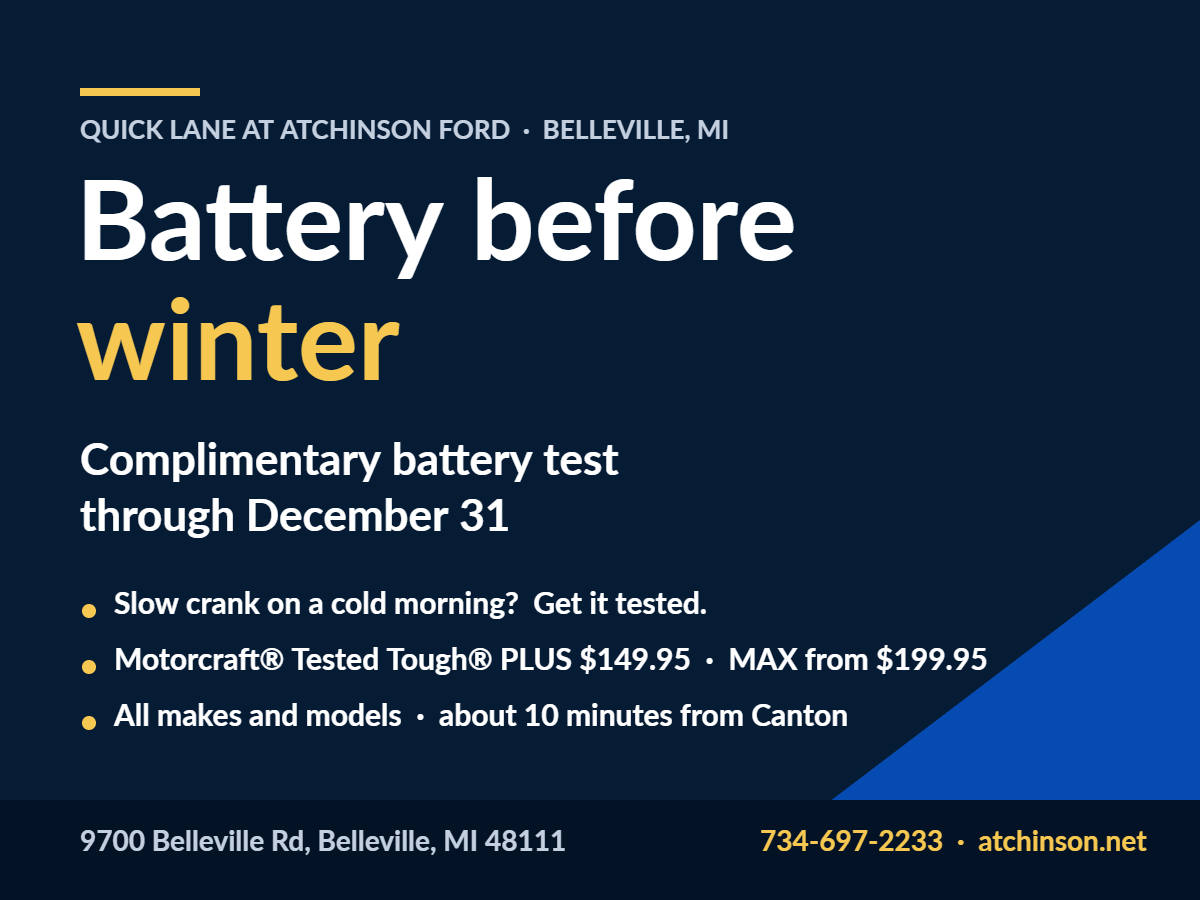
Battery before winter: complimentary battery test through December 31, 2026 at Quick Lane at Atchinson Ford in Belleville, MI, about 10 minutes from Canton

Car Battery Before Winter: When to Replace It, Why Cold Exposes a Weak Battery, and Your Motorcraft Options Near Canton, MI

Published November 23, 2026. Offers mentioned below are current as of this date; check the service coupons page for terms and expiration dates. Most dead batteries in Canton do not die in July. They die on the first single-digit morning in December, in a driveway on Cherry Hill or a commuter lot off I-275, after a summer of heat did the real damage and nobody noticed because the engine still started fine in October. This guide covers how to tell when a battery is getting close, why cold weather exposes a weak one so quickly, what the test at Quick Lane actually measures, and how we walk you through Ford's Motorcraft® Tested Tough® options at Quick Lane at Atchinson Ford in Belleville, about 10 minutes from the center of Canton. It is the fourth of our winter guides, after brakes, oil changes and tires. When does a car battery need to be replaced? A typical lead-acid battery in southeast Michigan lasts three to five years. Where a vehicle lands in that range depends less on the brand than on how it is used: lots of short trips, a start-stop system, a heavy accessory load (heated seats, remote start, dash cameras) and hot summers parked in the sun all shorten it. There is no mileage interval for a battery the way there is for oil, so the honest answer is the same one we give for brakes: have it tested, then plan from the number. At three years old, test it every fall. A conductance test takes a few minutes and tells you how much cranking capability is left compared with the battery's rating. The Works® package includes a battery test with every oil change, so most of our regulars never have to think about it. Before the first hard freeze. A battery that tests marginal in November will usually fail in January. Replacing it on your schedule in a warm bay costs the same as replacing it after a tow, minus the tow. Any time it has been jump-started. A jump gets you home; it does not tell you why the battery went flat. Have the battery and the charging system checked together. Look for the date code on the battery's label or case. Many list a month and year of manufacture, and if that date is more than four years back, go into winter expecting to replace it. The warning signs Slow cranking. The engine turns over, but slower than it used to, especially on a cold morning. This is the most common early sign and the easiest one to ignore. A click, or a rapid clicking, when you turn the key or press the start button. Not enough current to turn the starter. Dim headlights or interior lights at idle that brighten when you rev the engine. The battery is not holding the system up on its own. A battery or charging-system warning light, or a message such as "Battery Saver Mode" or "System off to save battery." Newer Fords manage power actively and will shut down accessories to protect the start. Treat the message as a test reminder, not a nuisance. Corrosion on the terminals, a swollen or bulging case, or a sulfur smell. Have it looked at promptly; a bulging case means the battery has been overcharged or frozen. Electronics acting up. A clock that resets, a radio that loses presets or a start-stop system that stops working can all trace back to a weak battery. If you can tell us when it happens (first start of the day, after the car sits for a weekend, only below freezing), the diagnosis goes faster. Why you should not wait Safety first. A battery does not strand you on a mild afternoon in the driveway. It strands you after dark in a parking lot at 8°F, with a phone at 12 percent, waiting for a jump from a stranger. Fixing a known-weak battery before winter is the cheapest safety upgrade on the list. It costs less early. A battery replaced on your schedule is a battery; a battery replaced after it strands you is a battery plus a tow, a missed morning and sometimes a damaged alternator that spent weeks trying to charge a cell that would not take a charge. Fuel economy and the systems that depend on it. If your vehicle has auto start-stop, it quietly turns the feature off when the battery cannot support a restart, and the fuel savings go with it. A weak battery also keeps the alternator working harder than it should, which is load on the engine. A healthy battery lets every system do its job. Your electronics. Modern vehicles are rolling computer networks, and low or unstable voltage is the enemy of every module on the bus. Intermittent faults that look like expensive electrical problems are sometimes a tired battery. Resale and trade-in value. A fresh battery with a dated receipt and a warranty is one more line that makes a trade-in appraisal easy. Our trade-in FAQ covers what else appraisers look for. Why batteries fail in the cold Two things happen at once when the temperature drops. The chemical reaction inside the battery slows, so it can deliver less current: AAA's testing puts a battery at about 35 percent weaker at 32°F and about 60 percent weaker at 0°F. At the same time, cold engine oil thickens and the engine needs roughly twice the cranking power to turn over. A battery that had plenty of margin in September can run out of it on the first morning below 10°F. Heat did the damage; cold reveals it. Summer heat speeds up corrosion of the plates and evaporates electrolyte. By November the battery is weaker than it looks, and the cold is just the first time it is asked to prove itself. Short winter trips do not recharge it. A cold start takes a big bite out of the battery, and then the defroster, the blower, heated seats, wipers and headlights all run at once. A 10-minute drive to the grocery store on Ford Road may not put back what the start took out, and over a few weeks the battery slowly drains. Parasitic draw adds up. Alarm systems, connected-vehicle modems and dash cameras draw a little current around the clock. On a vehicle that sits for days at a time, that draw matters more in winter. A frozen battery is a dead battery. A fully charged battery will not freeze in a Michigan winter; a discharged one can. If a battery has been frozen, replace it rather than trying to recharge it. Canton driving is a mix of short trips around Ford Road and Michigan Avenue and highway runs on I-275 and M-14. The short-trip half of that pattern is what wears a battery down in winter, which is why a test before the cold arrives is worth the few minutes. What the test at Quick Lane measures The technician connects a conductance tester to the battery, which reads the battery's internal condition and reports its available cold cranking amps against the rating printed on the label. A battery that reads well below its rating is on its way out, even if it started the car that morning. The test also checks the charging system, because a battery that keeps going flat is sometimes an alternator or a loose connection, and replacing the battery alone would not fix that. Through December 31, 2026, the battery test at Quick Lane is complimentary (visual inspection and test with the tester; hybrid battery testing excluded), and it is included in The Works® package as well. Good, better, best: the battery options we walk you through Every replacement starts with the right group size, cold cranking amp rating and terminal layout for your vehicle, and the desk will confirm those from your VIN before quoting anything. Then there are three tiers, and the test results, your vehicle's equipment and how long you plan to keep it decide which one makes sense. Good: Motorcraft® Tested Tough® PLUS Ford's standard-duty battery, built to Motorcraft specifications and backed by a 24-month free-replacement warranty. Through December 31, 2026, Tested Tough PLUS batteries are $149.95 MSRP, or 30,000 Ford Rewards points, with exchange; taxes and installation are extra. For an older vehicle, a second car or a daily driver without a heavy electrical load, this is usually the right call. Better: Motorcraft® Tested Tough® MAX Motorcraft's premium battery, tested beyond the industry's standard cold-crank and vibration requirements and backed by a 36-month free-replacement warranty inside a 100-month limited warranty (see the desk for the terms). Through December 31, 2026, Tested Tough MAX batteries start at $199.95 MSRP, or 40,000 Ford Rewards points, with exchange. If you keep your vehicles a long time, commute daily or run a lot of accessories, the longer coverage is worth the difference. Best: Motorcraft® Tested Tough® MAX AGM, where your vehicle calls for it Many late-model vehicles, including Fords with auto start-stop and vehicles with large infotainment and driver-assist systems, were built with an absorbed glass mat (AGM) battery and should be replaced with one. AGM batteries handle deep cycling and repeated restarts far better than a conventional battery, and installing a conventional battery in a vehicle designed for AGM shortens its life and can confuse the charging system. If your vehicle came with AGM, the Tested Tough MAX AGM is the best tier; the technician will tell you which type your vehicle needs. On most modern vehicles the new battery also has to be registered with the vehicle's battery management system, which is part of the installation at Quick Lane. Whichever tier you choose, Motorcraft battery warranties on dealer-installed batteries include complimentary towing if the battery fails within the warranty period, and all Motorcraft parts installed at Quick Lane carry Ford's parts warranty. What is on offer right now Complimentary battery test through December 31, 2026: visual inspection and test with the tester. Hybrid battery testing excluded. Motorcraft® Tested Tough® PLUS batteries, $149.95 MSRP or 30,000 Ford Rewards points, with a 24-month free-replacement warranty. Through December 31, 2026; with exchange, taxes and installation extra. Motorcraft® Tested Tough® MAX batteries from $199.95 MSRP or 40,000 Ford Rewards points, with a 36-month free-replacement warranty. Through December 31, 2026; with exchange, taxes and installation extra. The Works® synthetic blend oil change package from $89.95 through December 31 includes the battery test, a tire rotation and a brake inspection, and the $20 oil change rebate (or 5,000 Ford Rewards points) runs on oil changes from November 17 through January 4. Ford Rewards. Battery work earns points, and the Ford Rewards membership needed for the battery offers can be set up at the desk. Service Now, Pay Later. If a battery and a set of tires land in the same month, ask about Quick Lane financing. Full terms are on the service coupons page and the Quick Lane specials page. How to get it done from Canton Book online or call Quick Lane at 734-697-2233. Tell us the year, make, model and mileage, whether the vehicle has start-stop, and what you have noticed on cold mornings. Drive down Canton Center Road; it becomes Belleville Road at Michigan Avenue. Quick Lane is at 9700 Belleville Road, next to the dealership, about 10 minutes from the center of Canton. From I-275, use the Ecorse Road exit. Get the test results. If the battery is healthy, you leave with a number and a date to test again. If it is not, choose the tier, and the replacement is usually done while you wait. If the vehicle will not start at all, call first: a jump pack at the curb or a visit from the Ford Mobile Service van at 734-706-1892 may be simpler than a tow. Our Quick Lane battery service page has the details, our battery service advice page explains the common symptoms, and the oil change near Canton page covers The Works, which includes the battery test. For a charging-system fault or a Ford warning light that stays on, the main Atchinson Ford Service Center is at 9800 Belleville Road; our electrical repair page explains what a diagnosis there involves. Questions we hear every November How long does a battery replacement take? The test takes a few minutes. On most vehicles a replacement is under an hour, including registering the new battery with the vehicle's battery management system where that applies. Vehicles with the battery under a seat or in the trunk can take a little longer. My battery tested fine last year. Do I need to test it again? Yes, if it is three years old or more. A battery can go from passing to failing inside one summer, and the test is complimentary through December 31. Can I just buy a battery from a parts store? You can, but on many late-model vehicles the battery type (AGM versus conventional), the group size and the battery management registration all matter, and getting one of them wrong shortens the new battery's life. At Quick Lane the right battery is confirmed from the VIN, installed, registered and covered by a warranty that includes towing. Will a new battery fix my slow cold start if the problem is something else? Not if the cause is the starter, a corroded cable or the charging system, which is why the test covers the charging system too. If the battery tests healthy, we will tell you, and the Service Center next door can diagnose the rest. Do you service non-Ford vehicles? Yes. Quick Lane services all makes and models, and Motorcraft Tested Tough batteries are available in group sizes that fit most vehicles on the road. Battery or tires first? If the battery tests weak, the battery, because it decides whether the car moves at all. Then tires, because they decide whether it stops. Our tires near Canton page covers the current $150 rebate, which runs through December 6. Complimentary battery test and Motorcraft® Tested Tough® battery offers per the coupon terms; see the service coupons page and participating dealer for details. Prices are MSRP with exchange; taxes and installation extra. Ford Rewards membership required for the battery offers. Ford may change or discontinue these programs at any time. Motorcraft® and Tested Tough® are registered trademarks of Ford Motor Company.
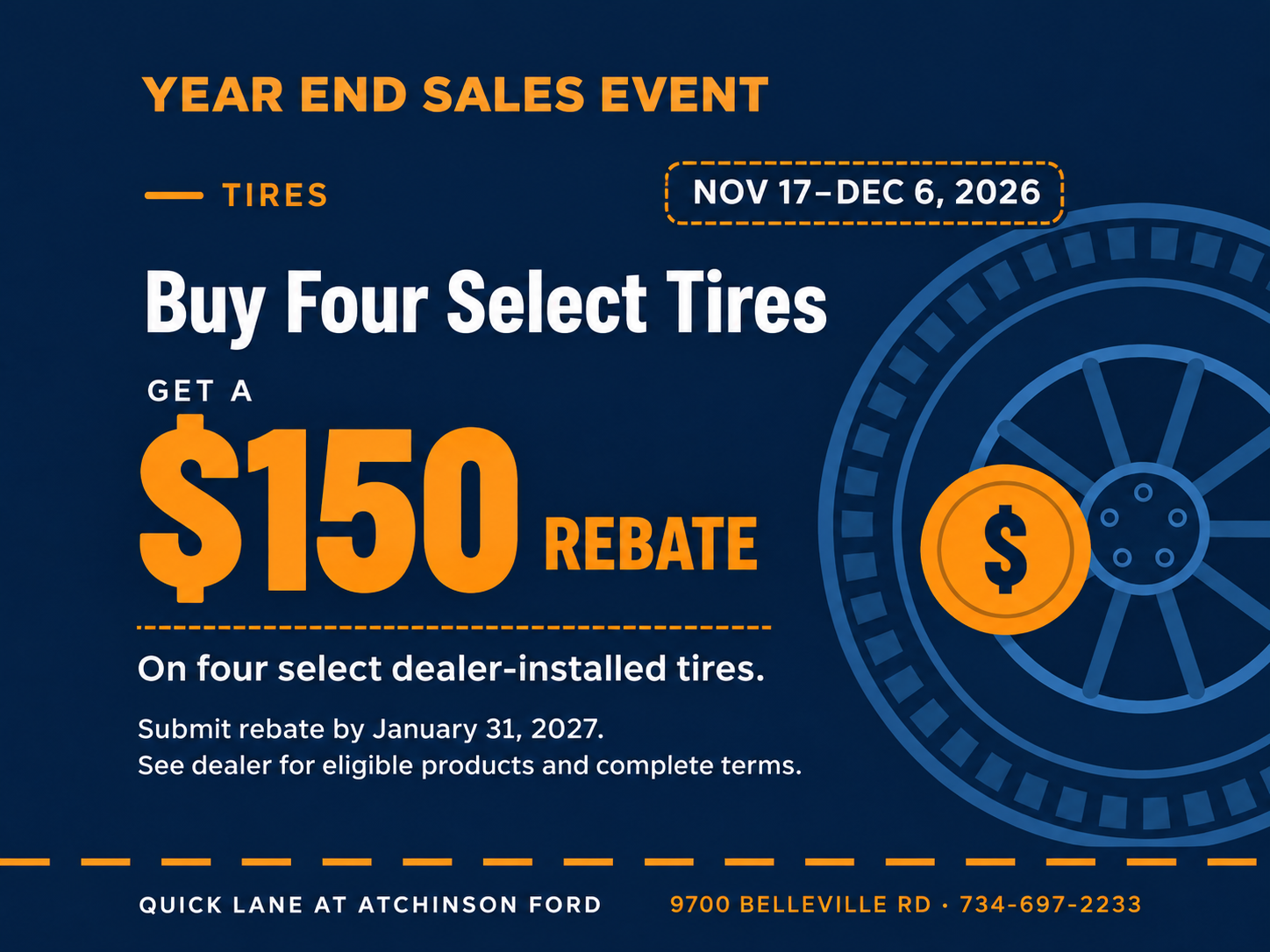
$150 rebate on four select dealer-installed tires at Quick Lane at Atchinson Ford in Belleville, MI, November 17 through December 6, 2026

Tires Before Winter: When to Replace Them, Why Tread Matters in Rain and Snow, and Good-Better-Best Options Near Canton, MI

Published November 20, 2026. Offers mentioned below are current as of this date; check the service coupons page for terms and expiration dates. Your tires are the only part of the vehicle that touches the road, and in a Michigan winter they are asked to do everything at once: grip in slush, drain standing water on Michigan Avenue, hold air through a 40-degree temperature swing, and survive the potholes that open up with every freeze and thaw. This guide covers when tires need replacing, why worn tread is a bigger problem in rain and snow than most drivers think, how we walk you through the good, better and best options at Quick Lane, and what good tires are worth in fuel economy and the life of the rest of your vehicle. Quick Lane at Atchinson Ford is in Belleville, about 10 minutes from the center of Canton, carries more than a dozen major brands, and services all makes and models. When do tires need to be replaced? Tread depth decides it, and the number most people know is the wrong one. The legal minimum in most states is 2/32 of an inch, but tires lose most of their wet and snow traction well before that. AAA's testing found that tires worn to 4/32" needed an extra 87 feet, about 43 percent more, to stop from highway speed on wet pavement compared with new tires. At the moment the new tires had stopped, the car on worn tires was still doing 40 mph. AAA's recommendation, and ours, is to plan replacement at 4/32"; if you rely on the tires in snow, start shopping at 6/32". The quarter test. Put a quarter upside down in a tread groove. If you can see the top of Washington's head, you are at or below 4/32" and it is time to shop. Age. Rubber hardens and cracks with time even if the tread looks fine. Most tire makers recommend replacement at ten years regardless of tread, and an inspection after six. The date code is the last four digits of the DOT number on the sidewall (week and year). Damage and uneven wear. Bulges, cuts, cords showing, or wear on one edge or in the center. Uneven wear usually means an alignment or pressure problem that should be fixed before new tires go on. Every oil change. The Works® package includes a tire rotation and pressure check, so tread depth gets measured at every visit without you asking. Why tires matter more once the weather turns Rain. Tread grooves exist to pump water out from under the tire. Half-worn tread moves half as much water, so the tire starts to hydroplane at a lower speed and stops later. In NHTSA's crash causation survey, tire and wheel problems were the single largest vehicle-related cause, about 35 percent of the crashes in which the vehicle itself was the critical reason. Snow and slush. Deep tread and sharp block edges are what bite into snow. By the time a tire is at 5/32", it has lost a large share of its snow traction even though it is still "legal." Cold. Below about 45 degrees, the rubber in a standard all-season tire stiffens and grips less, on dry pavement as well as wet. Winter tires and all-weather tires use compounds that stay flexible in the cold, which is why they stop shorter in January even on a clear road. Pressure. Tires lose about 1 psi for every 10-degree drop in temperature. A tire set in September can be 5 to 7 psi low by December, which is enough to wear the edges, hurt fuel economy and turn on the pressure light on the first cold morning. The pressure on the door-jamb label is the one to use, not the number on the sidewall. Potholes. Freeze-thaw season starts in late winter around here, and a tire with worn or stiff sidewalls is more likely to be damaged by a pothole, and more likely to take a wheel or an alignment with it. Why you should not wait Safety is the obvious one, and the AAA numbers above make the case better than we can. The rest is money. Fuel economy. Properly inflated tires improve gas mileage by 0.6 percent on average and up to 3 percent in some cases, and under-inflation costs about 0.2 percent for every 1 psi the average pressure drops, according to the U.S. Department of Energy. Many newer tires are also designed for lower rolling resistance, which is why the right replacement tire can pay part of its cost back at the pump. Alignment and suspension. Driving on tires that are worn unevenly, or on a vehicle that is out of alignment, scrubs tread off the new set too. An alignment check with new tires protects the purchase; it is the difference between 40,000 miles and 25,000 from the same tire. Brakes. Your brakes can only use the grip the tires give them. New pads on bald tires still stop late. Before winter, the two go together, which is why the brake inspection is part of the same visit. Resale. Tires are one of the first things an appraiser checks because they are one of the first things a buyer will have to replace. Matched, newer tires help a trade appraisal; a mismatched set with 3/32" hurts it. Good, better, best: how we walk you through the options Quick Lane carries more than a dozen major brands, and every tire we sell is covered by Ford's Low Price Tire Guarantee: find a better price on the same tire within 30 days of purchase and we will beat it. So the choice is about the tire, not about where to buy it. The advisor starts with your vehicle's size and load rating, how many miles a year you drive, and whether you will run one set year-round or switch to winter tires. From there, three tiers. Good: a quality all-season from a value brand Brands such as Cooper, Hankook, General and Falken make solid all-season tires that meet the vehicle's specifications at a lower price. For a commuter car that mostly sees plowed roads, or a vehicle you plan to trade in the next couple of years, this tier makes sense. Several of these brands are included in the current $150 rebate (see below). Better: a premium all-season or all-weather tire Goodyear, Bridgestone, Firestone, Pirelli, Yokohama, Toyo and Nitto lines in this tier typically bring longer treadwear warranties, better wet braking and quieter rides. The step worth asking about for Canton drivers is an all-weather tire: it carries the three-peak mountain snowflake symbol, meaning it meets a real snow-traction standard, but it stays on the vehicle all year. For a family vehicle that has to get to Plymouth-Canton schools on an unplowed morning without a second set of tires, this is often the best value. Best: the premium touring tire, or a dedicated winter set Michelin and BFGoodrich sit at the top of the range for treadwear, wet grip and ride, and they carry their own rebate right now ($80 rebate plus a $70 service allowance on a set of four, through December 6). The other "best" answer is a second set: dedicated winter tires on their own wheels from November to March, and your summer or all-season set the rest of the year. Each set lasts roughly twice as long, the winter tires stop shorter on snow and ice than any all-season can, and the swap twice a year is a quick visit. For a rear-wheel-drive Mustang or a vehicle that has to be out before the plows, it is the safest setup there is. Whichever tier you choose, we install, balance and check alignment, and the tire rotation in every Works package keeps the set wearing evenly from then on. What is on offer right now $150 rebate (or 32,000 Ford Rewards Points) on a set of four dealer-installed Goodyear, Cooper, Hankook, Bridgestone, Firestone, Toyo, Pirelli, Yokohama or Nitto tires, valid November 17 through December 6, 2026. $80 rebate plus a $70 service allowance (or 32,000 points) on a set of four Michelin or BFGoodrich tires, same dates. $80 instant discount for active and retired military and first responders on a set of four qualifying tires, through December 31, 2026 (Hero Code required). Low Price Tire Guarantee: find a better price within 30 days and we beat it, on more than a dozen brands. The Works® at $89.95 through December 31 includes the rotation and pressure check with the oil change and brake inspection. Service Now, Pay Later: a set of four at a bad time is what Quick Lane financing is for. Rebates are submitted at Ford.com/service-rebates or by mail; terms are on the service coupons page. How to get it done from Canton Call Quick Lane at 734-697-2233 or use the tire finder on our Quick Lane tires page with your year, make, model and trim. Tell us how you drive and whether you want one set or two. We quote installed prices across the tiers and apply the current rebate or the price guarantee. Quick Lane is at 9700 Belleville Road, Belleville, next to the dealership, about 10 minutes from the center of Canton: down Canton Center Road, which becomes Belleville Road at Michigan Avenue, or I-275 to the Ecorse Road exit. Most sets are installed the same day if the tire is in stock; call ahead for special orders. The tires near Canton page has the FAQ, and our tire care advice page covers rotation, pressure and the quarter test in more detail. Questions we hear every November Do I really need winter tires in Canton? Not necessarily. A good all-weather or all-season tire with plenty of tread handles plowed roads. Winter tires are the right call if you must drive before the plows, drive a rear-wheel-drive vehicle, or want the shortest stopping distances on ice. All-wheel drive helps you go; it does not help you stop. Tires do. Should I replace two tires or four? Four is best, and on all-wheel-drive vehicles it is usually required so the tire diameters match. If you replace two, the new ones go on the rear for stability in the wet, regardless of which wheels drive. Can I get the rebate and the price guarantee? Usually, yes: the price guarantee is applied at the counter and the rebate is submitted to Ford afterward. Ask the advisor to show you the math on the quote before you decide. How long does it take? A set of four is usually about an hour once the tires are in hand. Call ahead for a current time. Do you install tires on non-Ford vehicles? Yes. Quick Lane services all makes and models, and the brands above cover nearly every size on the road. What else should I check before the first snow? Brakes, oil and the battery. Our posts on brakes before winter, oil changes before winter and car batteries before winter cover all three, and everything can be done in one visit; the battery test is complimentary through December 31. Tire rebate: dealer-installed purchases only; limit one tire rebate per retail vehicle (15 per fleet); $150 rebate or 32,000 Ford Rewards Points on a set of four Goodyear®, Cooper®, Hankook, Bridgestone, Firestone, Toyo® (excludes medium and commercial/Motorsport), Pirelli, Yokohama® and Nitto®; $80 rebate and $70 service allowance or 32,000 Ford Rewards Points on a set of four Michelin and BFGoodrich®; valid 11/17/26 to 12/6/26; submit by 1/31/27 at Ford.com/service-rebates or by mail; Ford Rewards membership required within 60 days of service invoice date to receive points. Military and First Responder tire discount: available to active and retired military and first responders; $80 instant discount on a set of four qualifying tires from participating brands; dealer-installed purchases only; present nontransferable Hero Code at purchase (requires ID.me validation); limit two Hero Codes per calendar year per customer; valid for tires purchased and installed 1/1/26 to 12/31/26. Low Price Tire Guarantee: dealer-installed retail/fleet purchases only; must present competitor's current ad for the exact tire within 30 days of purchase; online quotes must be for new tires from direct retailer sites (excludes marketplaces/third-party resellers). Ford may change or discontinue these programs at any time. See participating U.S. dealer for details. Quick Lane® and The Works® are registered trademarks of Ford Motor Company. Stopping-distance figures: AAA, "Tread Lightly: Worn Tires Put Drivers at Risk" (2018). Crash statistic: NHTSA, DOT HS 812 506. Fuel economy figures: U.S. Department of Energy, fueleconomy.gov.