Blog / Warranty

What Does the Ford New-Vehicle Warranty Cover? A Guide for Michigan Buyers

What Does the Ford New-Vehicle Warranty Cover? A Guide for Michigan Buyers

This content was aggregated from local dealer and data and insights provided by the USA Today Network Automotive Insights team using Google Gemini and the Vehicles for Sale Near Detroit – Free Press Edition marketplace writing team.


When you choose a new Ford, you're investing in quality and innovation built to last. For value-conscious shoppers planning long-term ownership, understanding the Ford new-vehicle warranty is key to enjoying years of confident driving. This guide explains the protection that comes with your new Ford, ensuring peace of mind on the roads of Belleville, MI, and beyond.


Your Ford New Vehicle Limited Warranty Explained

The Ford New Vehicle Limited Warranty provides comprehensive coverage against defects in materials or workmanship. This factory coverage is designed to protect your investment during the early years of ownership, offering confidence whether you're commuting through Canton, MI, or taking weekend trips from Ann Arbor, MI.


Bumper-to-Bumper Protection

The standard Ford New Vehicle Limited Warranty covers most vehicle components for 3 years or 36,000 miles, whichever comes first. This bumper-to-bumper coverage means that many parts of your new Ford are protected from unexpected issues, allowing you to focus on the joy of driving.


Powertrain Confidence

Beyond the general coverage, the Ford powertrain warranty provides specific protection for major components like your engine, transmission, and drive systems. This crucial coverage extends for 5 years or 60,000 miles, whichever comes first. Should you encounter a covered powertrain issue, you can rely on this warranty for repairs, ensuring your Ford continues to perform reliably.


Roadside Assistance

Life on the road can be unpredictable, but your new Ford comes with 24-hour Roadside Assistance for 5 years or 60,000 miles. This valuable benefit offers help with services like towing, flat tire changes, battery jump-starts, and fuel delivery, providing an extra layer of security wherever your journey takes you.


Corrosion Coverage

Ford vehicles are built with durability in mind, and the New Vehicle Limited Warranty includes coverage against corrosion (perforation only) for 5 years with unlimited mileage. This protection helps guard against rust-through on your vehicle's body panels, maintaining its appearance and structural integrity for years to come.

Hybrid and Electric Vehicle Component Coverage


For those driving a new Ford Hybrid or Electric Vehicle, specific components like the high-voltage battery and electric drive components receive extended coverage. This specialized protection typically lasts for 8 years or 100,000 miles, whichever comes first, ensuring the advanced technology in your eco-friendly Ford is well-protected.


Warranty vs. Routine Maintenance: What's Covered?

It's important to understand the difference between warranty-covered defects and routine maintenance. The Ford new-vehicle warranty addresses issues arising from manufacturing defects. This means if a part fails due to how it was made or assembled, it's typically covered.


However, the warranty generally does not cover routine maintenance items such as oil changes, tire rotations, brake pad replacements, or fluid top-offs. These are considered normal wear items or part of regular upkeep to keep your vehicle running smoothly. Damage resulting from accidents, misuse, or lack of proper maintenance also typically falls outside warranty protection. For specific details, always review the warranty guide for your particular Ford model.


The Value of Factory Coverage for Long-Term Ownership

For drivers planning to own their Ford long term, factory coverage provides significant peace of mind during the crucial early years. Knowing that major components are protected against defects allows you to focus on enjoying your vehicle without unexpected repair costs. While the Ford warranty coverage offers robust protection, keeping up with recommended maintenance remains important. Regular service not only helps your Ford perform at its best but can also prevent issues that might not be covered by warranty, ensuring your vehicle remains reliable for many years.


Why Buy From Atchinson Ford

At Atchinson Ford in Belleville, MI, we are dedicated to providing an outstanding car-buying and ownership experience. We offer a wide selection of new Ford vehicles for sale in Belleville, MI, backed by knowledgeable staff who can help you understand every aspect of your purchase, including the Ford new-vehicle warranty. Our commitment extends beyond the sale with expert Ford warranty service near Canton, MI, and reliable Ford service near Ypsilanti, MI. We are your trusted partner for all your Ford needs, making us a top choice for a Ford dealer near me.


Frequently Asked Questions

How long is the Ford new-vehicle warranty?

The standard Ford New Vehicle Limited Warranty provides bumper-to-bumper coverage for 3 years or 36,000 miles, whichever comes first. Powertrain coverage extends to 5 years or 60,000 miles.


What does the Ford powertrain warranty cover?

The Ford powertrain warranty covers major components like the engine, transmission, and drive systems, protecting against defects in materials or workmanship for 5 years or 60,000 miles.


Does the Ford warranty cover routine maintenance?

No, the Ford warranty generally covers manufacturing defects, not routine maintenance items like oil changes, tire rotations, or brake pads, which are considered normal wear and tear.


Visit Atchinson Ford Today

Ready to experience the confidence of owning a new Ford with excellent warranty protection? Visit Atchinson Ford in Belleville, MI, your premier destination for new Ford vehicles and expert Ford warranty Belleville MI service. Our team is here to answer all your questions and help you find the perfect Ford for your lifestyle. Explore our inventory and learn more about our services at Atchinson Ford, located at 9800 Belleville Rd., Belleville, Michigan. We serve the greater Detroit area and surrounding communities, including those searching for vehicles for sale near Detroit.


Written for Atchinson Ford
By the USA TODAY Network Automotive Insights Team, in collaboration with 
https://vehiclesforsaleneardetroit.com/ and the Vehicles for Sale Near Detroit – Free Press Edition.

Disclaimer: The content provided in this article is intended for informational purposes only. Vehicle images may not depict the exact model, trim, features, packages, accessories, or specifications described. Vehicle pricing, availability, features, and specifications are subject to change without notice. Please consult the dealership directly for complete and accurate vehicle information.
Posted in:

Recommended Posts

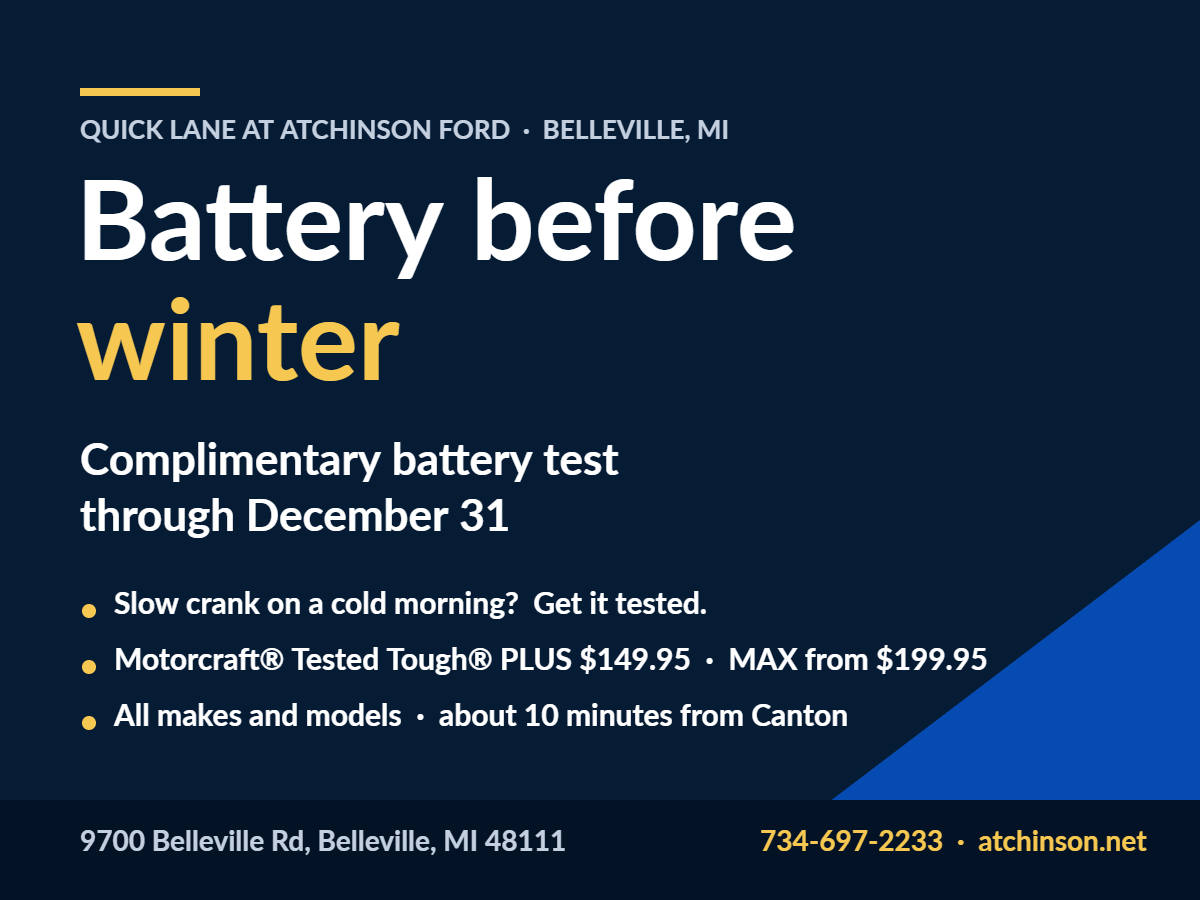
Battery before winter: complimentary battery test through December 31, 2026 at Quick Lane at Atchinson Ford in Belleville, MI, about 10 minutes from Canton

Car Battery Before Winter: When to Replace It, Why Cold Exposes a Weak Battery, and Your Motorcraft Options Near Canton, MI

Published November 23, 2026. Offers mentioned below are current as of this date; check the service coupons page for terms and expiration dates. Most dead batteries in Canton do not die in July. They die on the first single-digit morning in December, in a driveway on Cherry Hill or a commuter lot off I-275, after a summer of heat did the real damage and nobody noticed because the engine still started fine in October. This guide covers how to tell when a battery is getting close, why cold weather exposes a weak one so quickly, what the test at Quick Lane actually measures, and how we walk you through Ford's Motorcraft® Tested Tough® options at Quick Lane at Atchinson Ford in Belleville, about 10 minutes from the center of Canton. It is the fourth of our winter guides, after brakes, oil changes and tires. When does a car battery need to be replaced? A typical lead-acid battery in southeast Michigan lasts three to five years. Where a vehicle lands in that range depends less on the brand than on how it is used: lots of short trips, a start-stop system, a heavy accessory load (heated seats, remote start, dash cameras) and hot summers parked in the sun all shorten it. There is no mileage interval for a battery the way there is for oil, so the honest answer is the same one we give for brakes: have it tested, then plan from the number. At three years old, test it every fall. A conductance test takes a few minutes and tells you how much cranking capability is left compared with the battery's rating. The Works® package includes a battery test with every oil change, so most of our regulars never have to think about it. Before the first hard freeze. A battery that tests marginal in November will usually fail in January. Replacing it on your schedule in a warm bay costs the same as replacing it after a tow, minus the tow. Any time it has been jump-started. A jump gets you home; it does not tell you why the battery went flat. Have the battery and the charging system checked together. Look for the date code on the battery's label or case. Many list a month and year of manufacture, and if that date is more than four years back, go into winter expecting to replace it. The warning signs Slow cranking. The engine turns over, but slower than it used to, especially on a cold morning. This is the most common early sign and the easiest one to ignore. A click, or a rapid clicking, when you turn the key or press the start button. Not enough current to turn the starter. Dim headlights or interior lights at idle that brighten when you rev the engine. The battery is not holding the system up on its own. A battery or charging-system warning light, or a message such as "Battery Saver Mode" or "System off to save battery." Newer Fords manage power actively and will shut down accessories to protect the start. Treat the message as a test reminder, not a nuisance. Corrosion on the terminals, a swollen or bulging case, or a sulfur smell. Have it looked at promptly; a bulging case means the battery has been overcharged or frozen. Electronics acting up. A clock that resets, a radio that loses presets or a start-stop system that stops working can all trace back to a weak battery. If you can tell us when it happens (first start of the day, after the car sits for a weekend, only below freezing), the diagnosis goes faster. Why you should not wait Safety first. A battery does not strand you on a mild afternoon in the driveway. It strands you after dark in a parking lot at 8°F, with a phone at 12 percent, waiting for a jump from a stranger. Fixing a known-weak battery before winter is the cheapest safety upgrade on the list. It costs less early. A battery replaced on your schedule is a battery; a battery replaced after it strands you is a battery plus a tow, a missed morning and sometimes a damaged alternator that spent weeks trying to charge a cell that would not take a charge. Fuel economy and the systems that depend on it. If your vehicle has auto start-stop, it quietly turns the feature off when the battery cannot support a restart, and the fuel savings go with it. A weak battery also keeps the alternator working harder than it should, which is load on the engine. A healthy battery lets every system do its job. Your electronics. Modern vehicles are rolling computer networks, and low or unstable voltage is the enemy of every module on the bus. Intermittent faults that look like expensive electrical problems are sometimes a tired battery. Resale and trade-in value. A fresh battery with a dated receipt and a warranty is one more line that makes a trade-in appraisal easy. Our trade-in FAQ covers what else appraisers look for. Why batteries fail in the cold Two things happen at once when the temperature drops. The chemical reaction inside the battery slows, so it can deliver less current: AAA's testing puts a battery at about 35 percent weaker at 32°F and about 60 percent weaker at 0°F. At the same time, cold engine oil thickens and the engine needs roughly twice the cranking power to turn over. A battery that had plenty of margin in September can run out of it on the first morning below 10°F. Heat did the damage; cold reveals it. Summer heat speeds up corrosion of the plates and evaporates electrolyte. By November the battery is weaker than it looks, and the cold is just the first time it is asked to prove itself. Short winter trips do not recharge it. A cold start takes a big bite out of the battery, and then the defroster, the blower, heated seats, wipers and headlights all run at once. A 10-minute drive to the grocery store on Ford Road may not put back what the start took out, and over a few weeks the battery slowly drains. Parasitic draw adds up. Alarm systems, connected-vehicle modems and dash cameras draw a little current around the clock. On a vehicle that sits for days at a time, that draw matters more in winter. A frozen battery is a dead battery. A fully charged battery will not freeze in a Michigan winter; a discharged one can. If a battery has been frozen, replace it rather than trying to recharge it. Canton driving is a mix of short trips around Ford Road and Michigan Avenue and highway runs on I-275 and M-14. The short-trip half of that pattern is what wears a battery down in winter, which is why a test before the cold arrives is worth the few minutes. What the test at Quick Lane measures The technician connects a conductance tester to the battery, which reads the battery's internal condition and reports its available cold cranking amps against the rating printed on the label. A battery that reads well below its rating is on its way out, even if it started the car that morning. The test also checks the charging system, because a battery that keeps going flat is sometimes an alternator or a loose connection, and replacing the battery alone would not fix that. Through December 31, 2026, the battery test at Quick Lane is complimentary (visual inspection and test with the tester; hybrid battery testing excluded), and it is included in The Works® package as well. Good, better, best: the battery options we walk you through Every replacement starts with the right group size, cold cranking amp rating and terminal layout for your vehicle, and the desk will confirm those from your VIN before quoting anything. Then there are three tiers, and the test results, your vehicle's equipment and how long you plan to keep it decide which one makes sense. Good: Motorcraft® Tested Tough® PLUS Ford's standard-duty battery, built to Motorcraft specifications and backed by a 24-month free-replacement warranty. Through December 31, 2026, Tested Tough PLUS batteries are $149.95 MSRP, or 30,000 Ford Rewards points, with exchange; taxes and installation are extra. For an older vehicle, a second car or a daily driver without a heavy electrical load, this is usually the right call. Better: Motorcraft® Tested Tough® MAX Motorcraft's premium battery, tested beyond the industry's standard cold-crank and vibration requirements and backed by a 36-month free-replacement warranty inside a 100-month limited warranty (see the desk for the terms). Through December 31, 2026, Tested Tough MAX batteries start at $199.95 MSRP, or 40,000 Ford Rewards points, with exchange. If you keep your vehicles a long time, commute daily or run a lot of accessories, the longer coverage is worth the difference. Best: Motorcraft® Tested Tough® MAX AGM, where your vehicle calls for it Many late-model vehicles, including Fords with auto start-stop and vehicles with large infotainment and driver-assist systems, were built with an absorbed glass mat (AGM) battery and should be replaced with one. AGM batteries handle deep cycling and repeated restarts far better than a conventional battery, and installing a conventional battery in a vehicle designed for AGM shortens its life and can confuse the charging system. If your vehicle came with AGM, the Tested Tough MAX AGM is the best tier; the technician will tell you which type your vehicle needs. On most modern vehicles the new battery also has to be registered with the vehicle's battery management system, which is part of the installation at Quick Lane. Whichever tier you choose, Motorcraft battery warranties on dealer-installed batteries include complimentary towing if the battery fails within the warranty period, and all Motorcraft parts installed at Quick Lane carry Ford's parts warranty. What is on offer right now Complimentary battery test through December 31, 2026: visual inspection and test with the tester. Hybrid battery testing excluded. Motorcraft® Tested Tough® PLUS batteries, $149.95 MSRP or 30,000 Ford Rewards points, with a 24-month free-replacement warranty. Through December 31, 2026; with exchange, taxes and installation extra. Motorcraft® Tested Tough® MAX batteries from $199.95 MSRP or 40,000 Ford Rewards points, with a 36-month free-replacement warranty. Through December 31, 2026; with exchange, taxes and installation extra. The Works® synthetic blend oil change package from $89.95 through December 31 includes the battery test, a tire rotation and a brake inspection, and the $20 oil change rebate (or 5,000 Ford Rewards points) runs on oil changes from November 17 through January 4. Ford Rewards. Battery work earns points, and the Ford Rewards membership needed for the battery offers can be set up at the desk. Service Now, Pay Later. If a battery and a set of tires land in the same month, ask about Quick Lane financing. Full terms are on the service coupons page and the Quick Lane specials page. How to get it done from Canton Book online or call Quick Lane at 734-697-2233. Tell us the year, make, model and mileage, whether the vehicle has start-stop, and what you have noticed on cold mornings. Drive down Canton Center Road; it becomes Belleville Road at Michigan Avenue. Quick Lane is at 9700 Belleville Road, next to the dealership, about 10 minutes from the center of Canton. From I-275, use the Ecorse Road exit. Get the test results. If the battery is healthy, you leave with a number and a date to test again. If it is not, choose the tier, and the replacement is usually done while you wait. If the vehicle will not start at all, call first: a jump pack at the curb or a visit from the Ford Mobile Service van at 734-706-1892 may be simpler than a tow. Our Quick Lane battery service page has the details, our battery service advice page explains the common symptoms, and the oil change near Canton page covers The Works, which includes the battery test. For a charging-system fault or a Ford warning light that stays on, the main Atchinson Ford Service Center is at 9800 Belleville Road; our electrical repair page explains what a diagnosis there involves. Questions we hear every November How long does a battery replacement take? The test takes a few minutes. On most vehicles a replacement is under an hour, including registering the new battery with the vehicle's battery management system where that applies. Vehicles with the battery under a seat or in the trunk can take a little longer. My battery tested fine last year. Do I need to test it again? Yes, if it is three years old or more. A battery can go from passing to failing inside one summer, and the test is complimentary through December 31. Can I just buy a battery from a parts store? You can, but on many late-model vehicles the battery type (AGM versus conventional), the group size and the battery management registration all matter, and getting one of them wrong shortens the new battery's life. At Quick Lane the right battery is confirmed from the VIN, installed, registered and covered by a warranty that includes towing. Will a new battery fix my slow cold start if the problem is something else? Not if the cause is the starter, a corroded cable or the charging system, which is why the test covers the charging system too. If the battery tests healthy, we will tell you, and the Service Center next door can diagnose the rest. Do you service non-Ford vehicles? Yes. Quick Lane services all makes and models, and Motorcraft Tested Tough batteries are available in group sizes that fit most vehicles on the road. Battery or tires first? If the battery tests weak, the battery, because it decides whether the car moves at all. Then tires, because they decide whether it stops. Our tires near Canton page covers the current $150 rebate, which runs through December 6. Complimentary battery test and Motorcraft® Tested Tough® battery offers per the coupon terms; see the service coupons page and participating dealer for details. Prices are MSRP with exchange; taxes and installation extra. Ford Rewards membership required for the battery offers. Ford may change or discontinue these programs at any time. Motorcraft® and Tested Tough® are registered trademarks of Ford Motor Company.

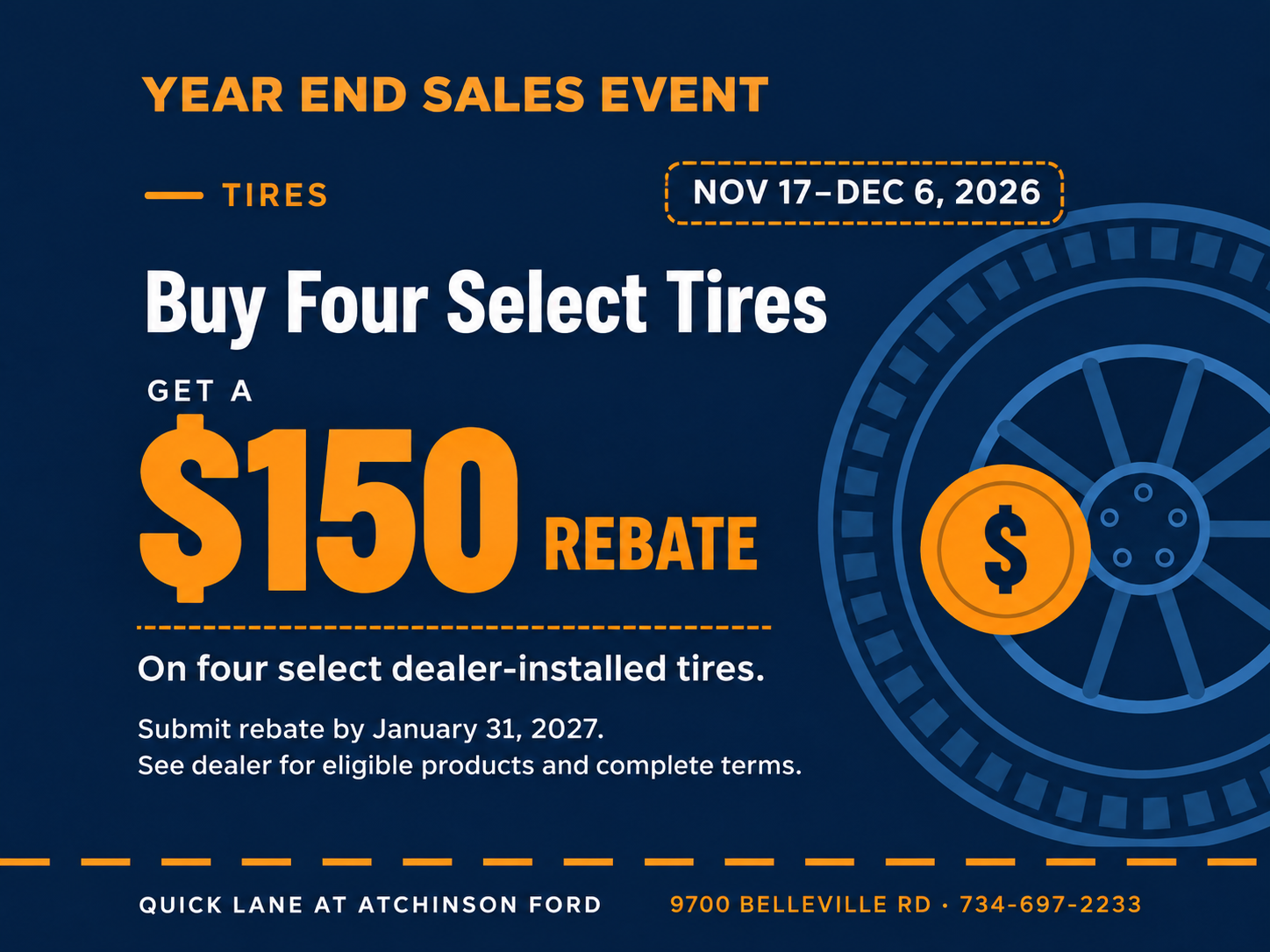
$150 rebate on four select dealer-installed tires at Quick Lane at Atchinson Ford in Belleville, MI, November 17 through December 6, 2026

Tires Before Winter: When to Replace Them, Why Tread Matters in Rain and Snow, and Good-Better-Best Options Near Canton, MI

Published November 20, 2026. Offers mentioned below are current as of this date; check the service coupons page for terms and expiration dates. Your tires are the only part of the vehicle that touches the road, and in a Michigan winter they are asked to do everything at once: grip in slush, drain standing water on Michigan Avenue, hold air through a 40-degree temperature swing, and survive the potholes that open up with every freeze and thaw. This guide covers when tires need replacing, why worn tread is a bigger problem in rain and snow than most drivers think, how we walk you through the good, better and best options at Quick Lane, and what good tires are worth in fuel economy and the life of the rest of your vehicle. Quick Lane at Atchinson Ford is in Belleville, about 10 minutes from the center of Canton, carries more than a dozen major brands, and services all makes and models. When do tires need to be replaced? Tread depth decides it, and the number most people know is the wrong one. The legal minimum in most states is 2/32 of an inch, but tires lose most of their wet and snow traction well before that. AAA's testing found that tires worn to 4/32" needed an extra 87 feet, about 43 percent more, to stop from highway speed on wet pavement compared with new tires. At the moment the new tires had stopped, the car on worn tires was still doing 40 mph. AAA's recommendation, and ours, is to plan replacement at 4/32"; if you rely on the tires in snow, start shopping at 6/32". The quarter test. Put a quarter upside down in a tread groove. If you can see the top of Washington's head, you are at or below 4/32" and it is time to shop. Age. Rubber hardens and cracks with time even if the tread looks fine. Most tire makers recommend replacement at ten years regardless of tread, and an inspection after six. The date code is the last four digits of the DOT number on the sidewall (week and year). Damage and uneven wear. Bulges, cuts, cords showing, or wear on one edge or in the center. Uneven wear usually means an alignment or pressure problem that should be fixed before new tires go on. Every oil change. The Works® package includes a tire rotation and pressure check, so tread depth gets measured at every visit without you asking. Why tires matter more once the weather turns Rain. Tread grooves exist to pump water out from under the tire. Half-worn tread moves half as much water, so the tire starts to hydroplane at a lower speed and stops later. In NHTSA's crash causation survey, tire and wheel problems were the single largest vehicle-related cause, about 35 percent of the crashes in which the vehicle itself was the critical reason. Snow and slush. Deep tread and sharp block edges are what bite into snow. By the time a tire is at 5/32", it has lost a large share of its snow traction even though it is still "legal." Cold. Below about 45 degrees, the rubber in a standard all-season tire stiffens and grips less, on dry pavement as well as wet. Winter tires and all-weather tires use compounds that stay flexible in the cold, which is why they stop shorter in January even on a clear road. Pressure. Tires lose about 1 psi for every 10-degree drop in temperature. A tire set in September can be 5 to 7 psi low by December, which is enough to wear the edges, hurt fuel economy and turn on the pressure light on the first cold morning. The pressure on the door-jamb label is the one to use, not the number on the sidewall. Potholes. Freeze-thaw season starts in late winter around here, and a tire with worn or stiff sidewalls is more likely to be damaged by a pothole, and more likely to take a wheel or an alignment with it. Why you should not wait Safety is the obvious one, and the AAA numbers above make the case better than we can. The rest is money. Fuel economy. Properly inflated tires improve gas mileage by 0.6 percent on average and up to 3 percent in some cases, and under-inflation costs about 0.2 percent for every 1 psi the average pressure drops, according to the U.S. Department of Energy. Many newer tires are also designed for lower rolling resistance, which is why the right replacement tire can pay part of its cost back at the pump. Alignment and suspension. Driving on tires that are worn unevenly, or on a vehicle that is out of alignment, scrubs tread off the new set too. An alignment check with new tires protects the purchase; it is the difference between 40,000 miles and 25,000 from the same tire. Brakes. Your brakes can only use the grip the tires give them. New pads on bald tires still stop late. Before winter, the two go together, which is why the brake inspection is part of the same visit. Resale. Tires are one of the first things an appraiser checks because they are one of the first things a buyer will have to replace. Matched, newer tires help a trade appraisal; a mismatched set with 3/32" hurts it. Good, better, best: how we walk you through the options Quick Lane carries more than a dozen major brands, and every tire we sell is covered by Ford's Low Price Tire Guarantee: find a better price on the same tire within 30 days of purchase and we will beat it. So the choice is about the tire, not about where to buy it. The advisor starts with your vehicle's size and load rating, how many miles a year you drive, and whether you will run one set year-round or switch to winter tires. From there, three tiers. Good: a quality all-season from a value brand Brands such as Cooper, Hankook, General and Falken make solid all-season tires that meet the vehicle's specifications at a lower price. For a commuter car that mostly sees plowed roads, or a vehicle you plan to trade in the next couple of years, this tier makes sense. Several of these brands are included in the current $150 rebate (see below). Better: a premium all-season or all-weather tire Goodyear, Bridgestone, Firestone, Pirelli, Yokohama, Toyo and Nitto lines in this tier typically bring longer treadwear warranties, better wet braking and quieter rides. The step worth asking about for Canton drivers is an all-weather tire: it carries the three-peak mountain snowflake symbol, meaning it meets a real snow-traction standard, but it stays on the vehicle all year. For a family vehicle that has to get to Plymouth-Canton schools on an unplowed morning without a second set of tires, this is often the best value. Best: the premium touring tire, or a dedicated winter set Michelin and BFGoodrich sit at the top of the range for treadwear, wet grip and ride, and they carry their own rebate right now ($80 rebate plus a $70 service allowance on a set of four, through December 6). The other "best" answer is a second set: dedicated winter tires on their own wheels from November to March, and your summer or all-season set the rest of the year. Each set lasts roughly twice as long, the winter tires stop shorter on snow and ice than any all-season can, and the swap twice a year is a quick visit. For a rear-wheel-drive Mustang or a vehicle that has to be out before the plows, it is the safest setup there is. Whichever tier you choose, we install, balance and check alignment, and the tire rotation in every Works package keeps the set wearing evenly from then on. What is on offer right now $150 rebate (or 32,000 Ford Rewards Points) on a set of four dealer-installed Goodyear, Cooper, Hankook, Bridgestone, Firestone, Toyo, Pirelli, Yokohama or Nitto tires, valid November 17 through December 6, 2026. $80 rebate plus a $70 service allowance (or 32,000 points) on a set of four Michelin or BFGoodrich tires, same dates. $80 instant discount for active and retired military and first responders on a set of four qualifying tires, through December 31, 2026 (Hero Code required). Low Price Tire Guarantee: find a better price within 30 days and we beat it, on more than a dozen brands. The Works® at $89.95 through December 31 includes the rotation and pressure check with the oil change and brake inspection. Service Now, Pay Later: a set of four at a bad time is what Quick Lane financing is for. Rebates are submitted at Ford.com/service-rebates or by mail; terms are on the service coupons page. How to get it done from Canton Call Quick Lane at 734-697-2233 or use the tire finder on our Quick Lane tires page with your year, make, model and trim. Tell us how you drive and whether you want one set or two. We quote installed prices across the tiers and apply the current rebate or the price guarantee. Quick Lane is at 9700 Belleville Road, Belleville, next to the dealership, about 10 minutes from the center of Canton: down Canton Center Road, which becomes Belleville Road at Michigan Avenue, or I-275 to the Ecorse Road exit. Most sets are installed the same day if the tire is in stock; call ahead for special orders. The tires near Canton page has the FAQ, and our tire care advice page covers rotation, pressure and the quarter test in more detail. Questions we hear every November Do I really need winter tires in Canton? Not necessarily. A good all-weather or all-season tire with plenty of tread handles plowed roads. Winter tires are the right call if you must drive before the plows, drive a rear-wheel-drive vehicle, or want the shortest stopping distances on ice. All-wheel drive helps you go; it does not help you stop. Tires do. Should I replace two tires or four? Four is best, and on all-wheel-drive vehicles it is usually required so the tire diameters match. If you replace two, the new ones go on the rear for stability in the wet, regardless of which wheels drive. Can I get the rebate and the price guarantee? Usually, yes: the price guarantee is applied at the counter and the rebate is submitted to Ford afterward. Ask the advisor to show you the math on the quote before you decide. How long does it take? A set of four is usually about an hour once the tires are in hand. Call ahead for a current time. Do you install tires on non-Ford vehicles? Yes. Quick Lane services all makes and models, and the brands above cover nearly every size on the road. What else should I check before the first snow? Brakes, oil and the battery. Our posts on brakes before winter, oil changes before winter and car batteries before winter cover all three, and everything can be done in one visit; the battery test is complimentary through December 31. Tire rebate: dealer-installed purchases only; limit one tire rebate per retail vehicle (15 per fleet); $150 rebate or 32,000 Ford Rewards Points on a set of four Goodyear®, Cooper®, Hankook, Bridgestone, Firestone, Toyo® (excludes medium and commercial/Motorsport), Pirelli, Yokohama® and Nitto®; $80 rebate and $70 service allowance or 32,000 Ford Rewards Points on a set of four Michelin and BFGoodrich®; valid 11/17/26 to 12/6/26; submit by 1/31/27 at Ford.com/service-rebates or by mail; Ford Rewards membership required within 60 days of service invoice date to receive points. Military and First Responder tire discount: available to active and retired military and first responders; $80 instant discount on a set of four qualifying tires from participating brands; dealer-installed purchases only; present nontransferable Hero Code at purchase (requires ID.me validation); limit two Hero Codes per calendar year per customer; valid for tires purchased and installed 1/1/26 to 12/31/26. Low Price Tire Guarantee: dealer-installed retail/fleet purchases only; must present competitor's current ad for the exact tire within 30 days of purchase; online quotes must be for new tires from direct retailer sites (excludes marketplaces/third-party resellers). Ford may change or discontinue these programs at any time. See participating U.S. dealer for details. Quick Lane® and The Works® are registered trademarks of Ford Motor Company. Stopping-distance figures: AAA, "Tread Lightly: Worn Tires Put Drivers at Risk" (2018). Crash statistic: NHTSA, DOT HS 812 506. Fuel economy figures: U.S. Department of Energy, fueleconomy.gov.

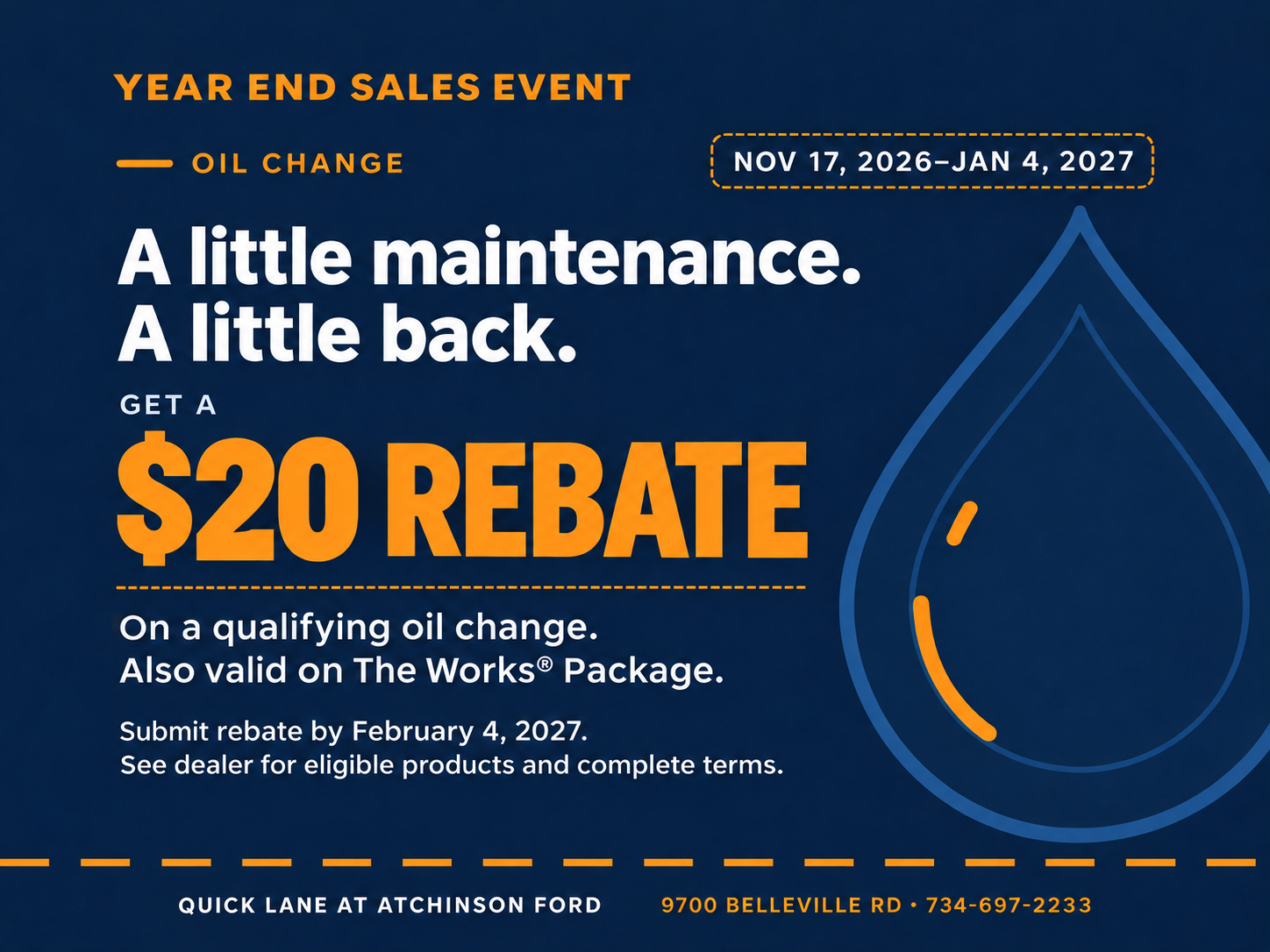
$20 rebate on a qualifying oil change, including The Works package, at Quick Lane at Atchinson Ford in Belleville, MI, through January 4, 2027

Oil Change Before Winter: When It's Due, Why Cold Weather Changes the Math, and Motorcraft Oil Options Near Canton, MI

Published November 20, 2026. Offers mentioned below are current as of this date; check the service coupons page for terms and expiration dates. An oil change is the cheapest thing you will do for your engine all year, and the one that does the most for it. It also happens to be the easiest way to get a full look at the vehicle before winter, because The Works® package bundles a tire rotation, brake inspection and battery test into the same visit. This guide covers when your oil is actually due, why the interval matters more in cold weather, how Ford's Motorcraft® oils stack up from good to better to best, and what it is worth to you in fuel economy, repair bills and resale. Quick Lane at Atchinson Ford is in Belleville, about 10 minutes from the center of Canton, and services all makes and models. When is my oil change due? The old 3,000-mile rule is gone. Modern oils and engines go much further, and most Fords built since 2008 have Ford's Intelligent Oil-Life Monitor®, which calculates the interval from how you actually drive rather than from a fixed number. On most of those vehicles the limit under normal driving is 10,000 miles or one year, whichever comes first, and the monitor shortens it when it sees short trips, idling, towing, dusty roads or extreme temperatures. The right answer for your vehicle is in three places: The oil-life reminder in the instrument cluster or the FordPass® app. Do not wait for 0 percent; when it says 15 to 20 percent, book the visit. Your owner's manual or Ford's online maintenance schedule, which also lists the oil specification and capacity. The calendar. Oil degrades with time, not just miles. If it has been a year, it is due even if the mileage is low. Low-mileage drivers are exactly the ones the one-year rule is for. If you drive something other than a Ford, the same logic applies: follow the manufacturer's interval for your oil type and driving conditions, and tell the advisor how you drive. Short trips around Canton count as severe service in the manual, not normal service. Why the interval matters more in winter Cold starts are where engines wear. Most engine wear happens in the first minute after a cold start, before the oil has fully circulated. Oil thickens as the temperature drops, so the colder the morning, the longer that minute takes. Fresh oil of the correct grade flows fastest; old oil that has thickened with contaminants flows slowest. Short trips never cook off the moisture. A cold engine produces condensation and lets a little unburned fuel past the rings. On a long drive the oil reaches full temperature and boils that off. On a January week of five-minute trips to the school and the store, it never does, and the oil picks up water and fuel that reduce its ability to protect. This is why the oil-life monitor shortens the interval in winter even if your mileage did not change. The rest of the vehicle is under stress too. Batteries lose cranking power in the cold, wiper blades harden, coolant and washer fluid need to be rated for the temperature, and tire pressures drop about 1 psi for every 10-degree fall in temperature. An oil change visit is when all of that gets checked. Why you should not stretch it Engine life. Oil lubricates, cools, cleans and seals. As it ages, additives deplete, it thickens, and it stops suspending the soot and metal it picked up. Sludge and varnish are the result, and on modern turbocharged engines with tight tolerances and variable valve timing, that shows up as noise, rough running and expensive repairs. There is no cheaper insurance for an engine than oil changed on time. Fuel economy. The U.S. Department of Energy puts it plainly: using the manufacturer's recommended grade of motor oil improves gas mileage by 1 to 2 percent. Thick, worn-out oil costs you a little at every fill-up; the wrong grade costs you more. Warranty. Ford's powertrain coverage expects the maintenance in the owner's manual to be done on schedule. Service records from a Ford dealer or Quick Lane are the easiest way to show that if a warranty question ever comes up. Resale and trade-in value. An appraiser cannot see inside the engine, so the service history stands in for it. A vehicle with regular oil changes on file appraises more confidently than one with no record at all. If a trade is in the plan, keep the receipts; we can pull our own records when you come in for a trade estimate. Catching the next problem early. The vehicle checkup in The Works is where we find the worn belt, the weak battery and the tire that is wearing on one edge. Those are inexpensive now and expensive on the shoulder of I-275 in February. Good, better, best: Motorcraft® oil options Ford publishes an oil specification for every engine, and Motorcraft is the oil Ford builds and tests to it. The advisor will look up your spec and capacity; from there, these are the choices. Good: Motorcraft® Synthetic Blend Ford's standard oil for most gasoline engines and what comes in The Works package at $89.95 (through December 31, 2026). It meets the Ford specification for the engines it is recommended for, flows well in the cold, and is changed on the interval the oil-life monitor sets. For a normally driven Escape, Explorer, F-150 or Fusion, this is the right oil and there is no reason to pay for more. Better: Motorcraft® Full Synthetic Full synthetic oil is more stable at both ends of the thermometer: it flows more easily on a 5-degree morning and resists breaking down under heat better than a blend. Ford specifies full synthetic for a number of its EcoBoost® engines, and it is the better choice if you tow, idle a lot, make mostly short trips, or simply want the most protection between changes. If your Ford calls for it, it is not an upgrade, it is the requirement; the advisor will tell you which. Best: The Works® with the oil your engine was built for The best oil change is the one that comes with the inspection. The Works package pairs the correct Motorcraft oil (synthetic blend or full synthetic) and a Motorcraft oil filter with a tire rotation and pressure check, brake inspection, multi-point vehicle checkup, fluid top-off, battery test, filter check and a belts-and-hoses check. Before winter, that is the visit that finds the pads at 3 millimeters and the battery that will not start on the first below-zero morning. Super Duty® diesel owners have their own tier here: Motorcraft Super Duty diesel oil and filter, and a package built for the Power Stroke®. Whichever oil you choose, the filter should be a Motorcraft filter matched to the engine. A cheap filter with the right oil is still a cheap filter. What is on offer right now The Works® Synthetic Blend Oil Change package starts at $89.95 through December 31, 2026, including up to six quarts of Motorcraft oil and a Motorcraft filter, tire rotation and pressure check, brake inspection, vehicle checkup, fluid top-off, battery test, filter check and belts-and-hoses check (hybrid battery test excluded). $20 rebate or 5,000 Ford Rewards Points on an oil change, including The Works, valid November 17, 2026 through January 4, 2027; submit by February 4, 2027. Free battery test, and if it fails, Motorcraft Tested Tough® PLUS batteries at $149.95 MSRP and Tested Tough MAX from $199.95 MSRP through December 31. Complimentary brake inspection through December 31 if you want the brakes looked at outside of a Works visit. Ford Mobile Service: for routine maintenance we can come to your home or office in Canton; call 734-706-1892 for availability. Terms are on the service coupons page and the Quick Lane specials page. How to get it done from Canton Book online or call Quick Lane at 734-697-2233 with the year, make, model and mileage. Mention how you drive (short trips, towing, highway) so we can confirm the oil. Quick Lane is at 9700 Belleville Road, Belleville, next to the dealership: down Canton Center Road, which becomes Belleville Road at Michigan Avenue, about 10 minutes from the center of Canton. From I-275, use the Ecorse Road exit. No appointment is required, but calling ahead gets you a realistic wait. Ask for The Works if a rotation and inspection are due, and ask the advisor to reset the oil-life monitor before you leave. The oil change near Canton page has the FAQ, our oil types guide goes deeper on blends versus synthetics, and the oil change advice page covers the basics. The full menu is on the Quick Lane oil change page. Questions we hear every November Can I switch from synthetic blend to full synthetic? Yes, as long as the oil meets your engine's Ford specification. You do not need to flush anything; the advisor simply drains the old oil and fills with the new. Is full synthetic worth it if the manual says blend is fine? If you make mostly short trips, tow, or keep vehicles a long time, many drivers think so. If you drive normally and change on schedule, the blend meets the spec and protects the engine. Both are honest answers; it depends on how you use the vehicle. How long does it take? The Works is usually done while you wait. Call ahead and we will tell you the current wait before you leave Canton. Do you change oil on non-Ford vehicles? Yes. Quick Lane services all makes and models with the oil grade the manufacturer specifies. What else should I check before the first snow? Battery (free test), wiper blades, washer fluid rated for below-zero temperatures, tire tread and pressure, and brakes. Our posts on brakes before winter, tires before winter and car batteries before winter cover all three in detail, and the battery test is complimentary through December 31. The Works® package includes up to six quarts of Motorcraft® oil and Motorcraft oil filter; excludes hybrid battery test; see Service Advisor for details. $20 rebate or 5,000 Ford Rewards Points: limit one per vehicle; not valid on prior purchases; valid 11/17/26 to 1/4/27; submit by 2/4/27 at Ford.com/service-rebates or by mail; Ford Rewards membership required within 60 days of service invoice date to receive points. Battery offers per coupon terms. Ford Mobile Service offered by participating dealers; may be limited by availability, distance or other dealer criteria; excludes parts and repair charges. Ford may change or discontinue these programs at any time. Quick Lane®, Motorcraft®, The Works®, EcoBoost®, Super Duty®, Power Stroke®, Tested Tough® and FordPass® are trademarks of Ford Motor Company. Fuel economy figure: U.S. Department of Energy, fueleconomy.gov.