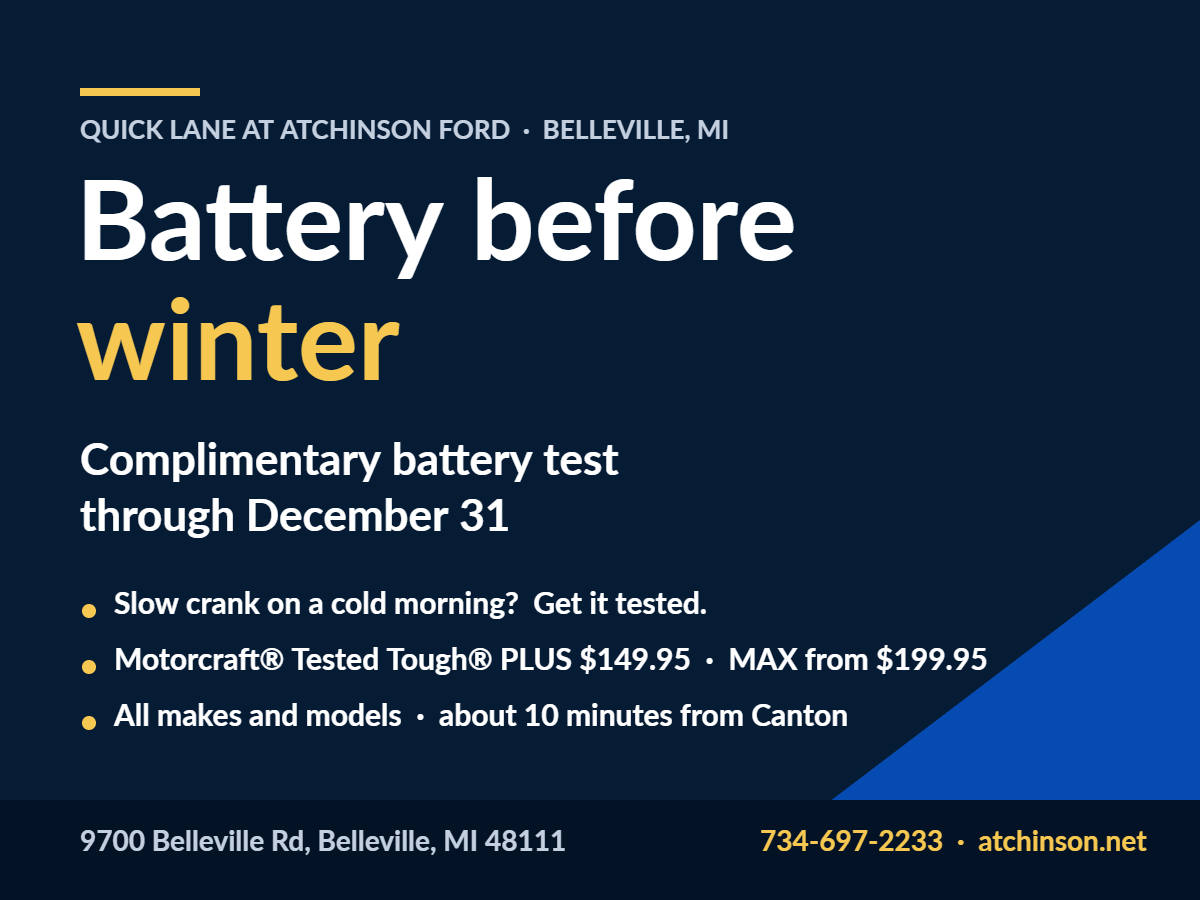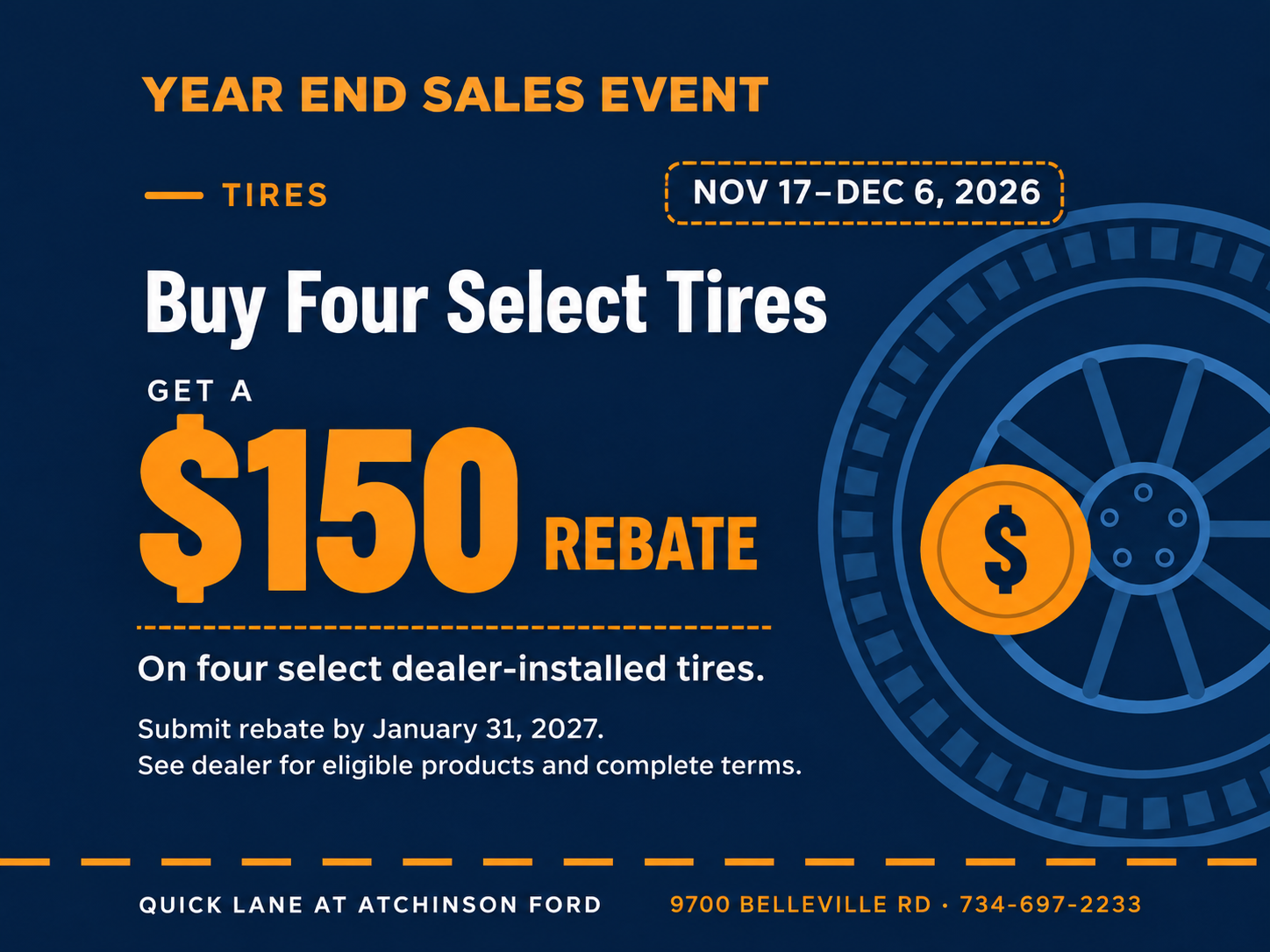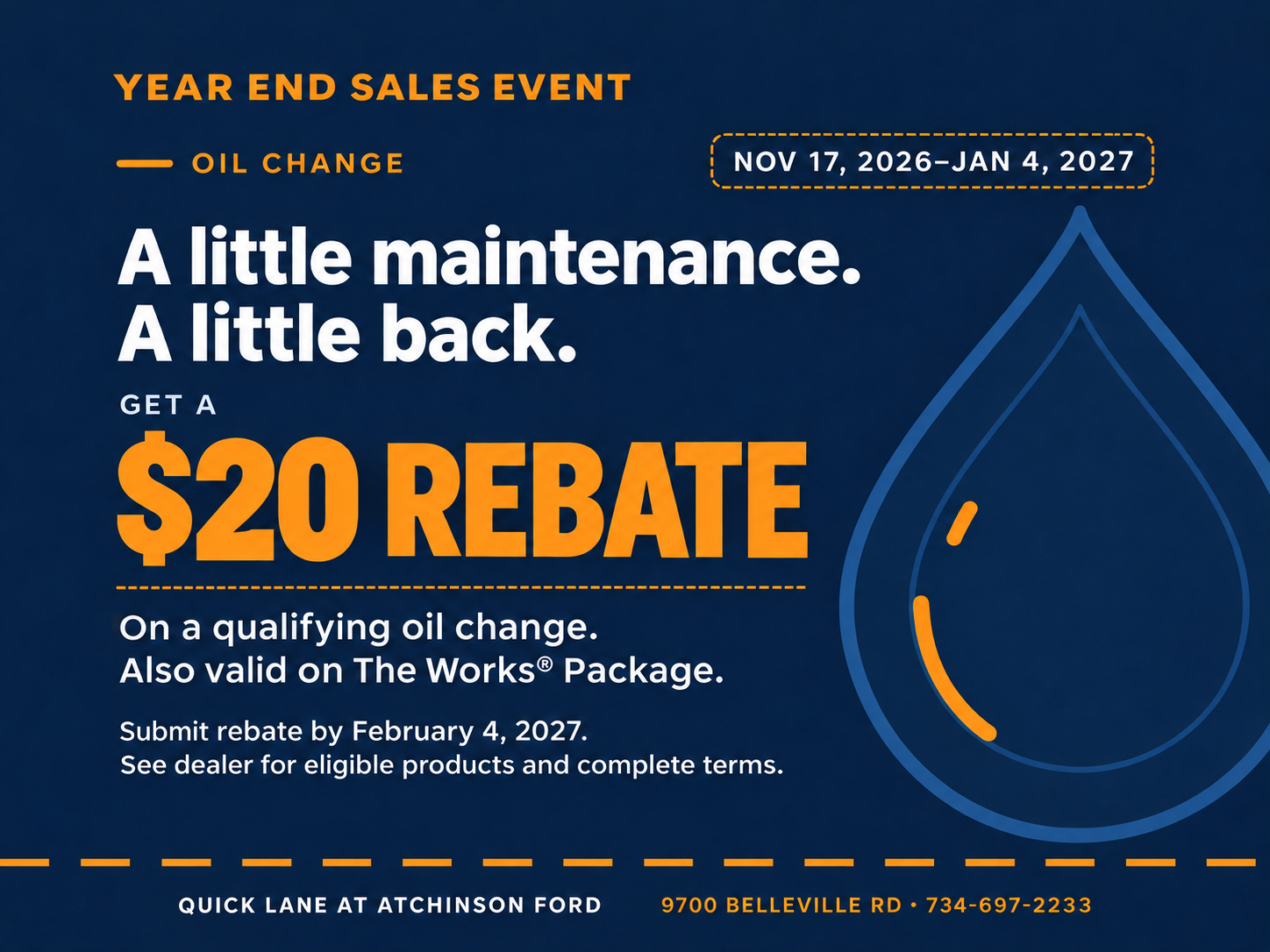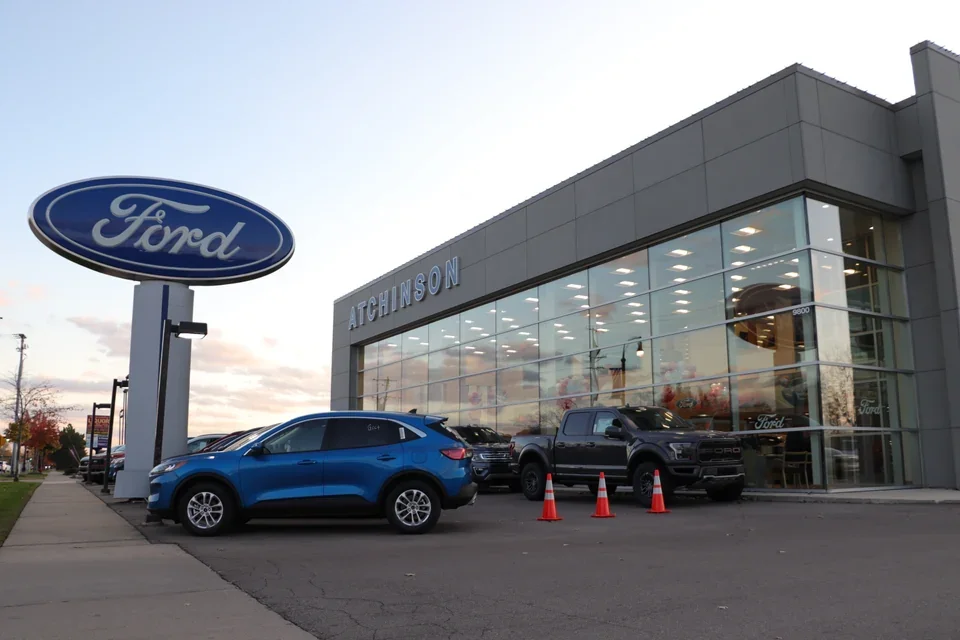

Published November 23, 2026. Offers mentioned below are current as of this date; check the service coupons page for terms and expiration dates. Most dead batteries in Canton do not die in July. They die on the first single-digit morning in December, in a driveway on Cherry Hill or a commuter lot off I-275, after a summer of heat did the real damage and nobody noticed because the engine still started fine in October. This guide covers how to tell when a battery is getting close, why cold weather exposes a weak one so quickly, what the test at Quick Lane actually measures, and how we walk you through Ford's Motorcraft® Tested Tough® options at Quick Lane at Atchinson Ford in Belleville, about 10 minutes from the center of Canton. It is the fourth of our winter guides, after brakes, oil changes and tires. When does a car battery need to be replaced? A typical lead-acid battery in southeast Michigan lasts three to five years. Where a vehicle lands in that range depends less on the brand than on how it is used: lots of short trips, a start-stop system, a heavy accessory load (heated seats, remote start, dash cameras) and hot summers parked in the sun all shorten it. There is no mileage interval for a battery the way there is for oil, so the honest answer is the same one we give for brakes: have it tested, then plan from the number. At three years old, test it every fall. A conductance test takes a few minutes and tells you how much cranking capability is left compared with the battery's rating. The Works® package includes a battery test with every oil change, so most of our regulars never have to think about it. Before the first hard freeze. A battery that tests marginal in November will usually fail in January. Replacing it on your schedule in a warm bay costs the same as replacing it after a tow, minus the tow. Any time it has been jump-started. A jump gets you home; it does not tell you why the battery went flat. Have the battery and the charging system checked together. Look for the date code on the battery's label or case. Many list a month and year of manufacture, and if that date is more than four years back, go into winter expecting to replace it. The warning signs Slow cranking. The engine turns over, but slower than it used to, especially on a cold morning. This is the most common early sign and the easiest one to ignore. A click, or a rapid clicking, when you turn the key or press the start button. Not enough current to turn the starter. Dim headlights or interior lights at idle that brighten when you rev the engine. The battery is not holding the system up on its own. A battery or charging-system warning light, or a message such as "Battery Saver Mode" or "System off to save battery." Newer Fords manage power actively and will shut down accessories to protect the start. Treat the message as a test reminder, not a nuisance. Corrosion on the terminals, a swollen or bulging case, or a sulfur smell. Have it looked at promptly; a bulging case means the battery has been overcharged or frozen. Electronics acting up. A clock that resets, a radio that loses presets or a start-stop system that stops working can all trace back to a weak battery. If you can tell us when it happens (first start of the day, after the car sits for a weekend, only below freezing), the diagnosis goes faster. Why you should not wait Safety first. A battery does not strand you on a mild afternoon in the driveway. It strands you after dark in a parking lot at 8°F, with a phone at 12 percent, waiting for a jump from a stranger. Fixing a known-weak battery before winter is the cheapest safety upgrade on the list. It costs less early. A battery replaced on your schedule is a battery; a battery replaced after it strands you is a battery plus a tow, a missed morning and sometimes a damaged alternator that spent weeks trying to charge a cell that would not take a charge. Fuel economy and the systems that depend on it. If your vehicle has auto start-stop, it quietly turns the feature off when the battery cannot support a restart, and the fuel savings go with it. A weak battery also keeps the alternator working harder than it should, which is load on the engine. A healthy battery lets every system do its job. Your electronics. Modern vehicles are rolling computer networks, and low or unstable voltage is the enemy of every module on the bus. Intermittent faults that look like expensive electrical problems are sometimes a tired battery. Resale and trade-in value. A fresh battery with a dated receipt and a warranty is one more line that makes a trade-in appraisal easy. Our trade-in FAQ covers what else appraisers look for. Why batteries fail in the cold Two things happen at once when the temperature drops. The chemical reaction inside the battery slows, so it can deliver less current: AAA's testing puts a battery at about 35 percent weaker at 32°F and about 60 percent weaker at 0°F. At the same time, cold engine oil thickens and the engine needs roughly twice the cranking power to turn over. A battery that had plenty of margin in September can run out of it on the first morning below 10°F. Heat did the damage; cold reveals it. Summer heat speeds up corrosion of the plates and evaporates electrolyte. By November the battery is weaker than it looks, and the cold is just the first time it is asked to prove itself. Short winter trips do not recharge it. A cold start takes a big bite out of the battery, and then the defroster, the blower, heated seats, wipers and headlights all run at once. A 10-minute drive to the grocery store on Ford Road may not put back what the start took out, and over a few weeks the battery slowly drains. Parasitic draw adds up. Alarm systems, connected-vehicle modems and dash cameras draw a little current around the clock. On a vehicle that sits for days at a time, that draw matters more in winter. A frozen battery is a dead battery. A fully charged battery will not freeze in a Michigan winter; a discharged one can. If a battery has been frozen, replace it rather than trying to recharge it. Canton driving is a mix of short trips around Ford Road and Michigan Avenue and highway runs on I-275 and M-14. The short-trip half of that pattern is what wears a battery down in winter, which is why a test before the cold arrives is worth the few minutes. What the test at Quick Lane measures The technician connects a conductance tester to the battery, which reads the battery's internal condition and reports its available cold cranking amps against the rating printed on the label. A battery that reads well below its rating is on its way out, even if it started the car that morning. The test also checks the charging system, because a battery that keeps going flat is sometimes an alternator or a loose connection, and replacing the battery alone would not fix that. Through December 31, 2026, the battery test at Quick Lane is complimentary (visual inspection and test with the tester; hybrid battery testing excluded), and it is included in The Works® package as well. Good, better, best: the battery options we walk you through Every replacement starts with the right group size, cold cranking amp rating and terminal layout for your vehicle, and the desk will confirm those from your VIN before quoting anything. Then there are three tiers, and the test results, your vehicle's equipment and how long you plan to keep it decide which one makes sense. Good: Motorcraft® Tested Tough® PLUS Ford's standard-duty battery, built to Motorcraft specifications and backed by a 24-month free-replacement warranty. Through December 31, 2026, Tested Tough PLUS batteries are $149.95 MSRP, or 30,000 Ford Rewards points, with exchange; taxes and installation are extra. For an older vehicle, a second car or a daily driver without a heavy electrical load, this is usually the right call. Better: Motorcraft® Tested Tough® MAX Motorcraft's premium battery, tested beyond the industry's standard cold-crank and vibration requirements and backed by a 36-month free-replacement warranty inside a 100-month limited warranty (see the desk for the terms). Through December 31, 2026, Tested Tough MAX batteries start at $199.95 MSRP, or 40,000 Ford Rewards points, with exchange. If you keep your vehicles a long time, commute daily or run a lot of accessories, the longer coverage is worth the difference. Best: Motorcraft® Tested Tough® MAX AGM, where your vehicle calls for it Many late-model vehicles, including Fords with auto start-stop and vehicles with large infotainment and driver-assist systems, were built with an absorbed glass mat (AGM) battery and should be replaced with one. AGM batteries handle deep cycling and repeated restarts far better than a conventional battery, and installing a conventional battery in a vehicle designed for AGM shortens its life and can confuse the charging system. If your vehicle came with AGM, the Tested Tough MAX AGM is the best tier; the technician will tell you which type your vehicle needs. On most modern vehicles the new battery also has to be registered with the vehicle's battery management system, which is part of the installation at Quick Lane. Whichever tier you choose, Motorcraft battery warranties on dealer-installed batteries include complimentary towing if the battery fails within the warranty period, and all Motorcraft parts installed at Quick Lane carry Ford's parts warranty. What is on offer right now Complimentary battery test through December 31, 2026: visual inspection and test with the tester. Hybrid battery testing excluded. Motorcraft® Tested Tough® PLUS batteries, $149.95 MSRP or 30,000 Ford Rewards points, with a 24-month free-replacement warranty. Through December 31, 2026; with exchange, taxes and installation extra. Motorcraft® Tested Tough® MAX batteries from $199.95 MSRP or 40,000 Ford Rewards points, with a 36-month free-replacement warranty. Through December 31, 2026; with exchange, taxes and installation extra. The Works® synthetic blend oil change package from $89.95 through December 31 includes the battery test, a tire rotation and a brake inspection, and the $20 oil change rebate (or 5,000 Ford Rewards points) runs on oil changes from November 17 through January 4. Ford Rewards. Battery work earns points, and the Ford Rewards membership needed for the battery offers can be set up at the desk. Service Now, Pay Later. If a battery and a set of tires land in the same month, ask about Quick Lane financing. Full terms are on the service coupons page and the Quick Lane specials page. How to get it done from Canton Book online or call Quick Lane at 734-697-2233. Tell us the year, make, model and mileage, whether the vehicle has start-stop, and what you have noticed on cold mornings. Drive down Canton Center Road; it becomes Belleville Road at Michigan Avenue. Quick Lane is at 9700 Belleville Road, next to the dealership, about 10 minutes from the center of Canton. From I-275, use the Ecorse Road exit. Get the test results. If the battery is healthy, you leave with a number and a date to test again. If it is not, choose the tier, and the replacement is usually done while you wait. If the vehicle will not start at all, call first: a jump pack at the curb or a visit from the Ford Mobile Service van at 734-706-1892 may be simpler than a tow. Our Quick Lane battery service page has the details, our battery service advice page explains the common symptoms, and the oil change near Canton page covers The Works, which includes the battery test. For a charging-system fault or a Ford warning light that stays on, the main Atchinson Ford Service Center is at 9800 Belleville Road; our electrical repair page explains what a diagnosis there involves. Questions we hear every November How long does a battery replacement take? The test takes a few minutes. On most vehicles a replacement is under an hour, including registering the new battery with the vehicle's battery management system where that applies. Vehicles with the battery under a seat or in the trunk can take a little longer. My battery tested fine last year. Do I need to test it again? Yes, if it is three years old or more. A battery can go from passing to failing inside one summer, and the test is complimentary through December 31. Can I just buy a battery from a parts store? You can, but on many late-model vehicles the battery type (AGM versus conventional), the group size and the battery management registration all matter, and getting one of them wrong shortens the new battery's life. At Quick Lane the right battery is confirmed from the VIN, installed, registered and covered by a warranty that includes towing. Will a new battery fix my slow cold start if the problem is something else? Not if the cause is the starter, a corroded cable or the charging system, which is why the test covers the charging system too. If the battery tests healthy, we will tell you, and the Service Center next door can diagnose the rest. Do you service non-Ford vehicles? Yes. Quick Lane services all makes and models, and Motorcraft Tested Tough batteries are available in group sizes that fit most vehicles on the road. Battery or tires first? If the battery tests weak, the battery, because it decides whether the car moves at all. Then tires, because they decide whether it stops. Our tires near Canton page covers the current $150 rebate, which runs through December 6. Complimentary battery test and Motorcraft® Tested Tough® battery offers per the coupon terms; see the service coupons page and participating dealer for details. Prices are MSRP with exchange; taxes and installation extra. Ford Rewards membership required for the battery offers. Ford may change or discontinue these programs at any time. Motorcraft® and Tested Tough® are registered trademarks of Ford Motor Company.