Blog / Quick Lane

Blog

All Quick Lane Belleville Ford Dealer Service New Ford New Inventory Belleville Ford Service Atchinson Ford Service Finance New Ford Models Ford Trucks 2026 Technology Belleville Used Cars Ford Services Ford Towing Green New Ford Inventory 2026 Ford Bronco 2026 Ford F-150 Ford F-150 Ford Service Center Rental Ford Bronco Ford Inventory 2025 Ford Models 2026 Ranger Atchinson Ford Ford Explorer models Ford Suv Parts Winter Maintenance 2025 Ford F-150s 2026 Ford Explorer 2026 Ford Maverick 2026 Ford Transit 2026 Mustang Ford Ford Bronco Sport Mustang People Pre-Owned Inventory 2024 Ford F-150 2026 Ford Expedition 2026 Mach-E Alternator Community Events Cooling System Ford Escape Ford Models 2024 Ford Protect Ford Technology Ford Tire Services FordPass Fuel Efficiency New Ford Escape New Ford SUVs Radiator Suspension Trade In Transmission USA Today Automotive Insights Team Used Ford Models Used Vehicles Warranty
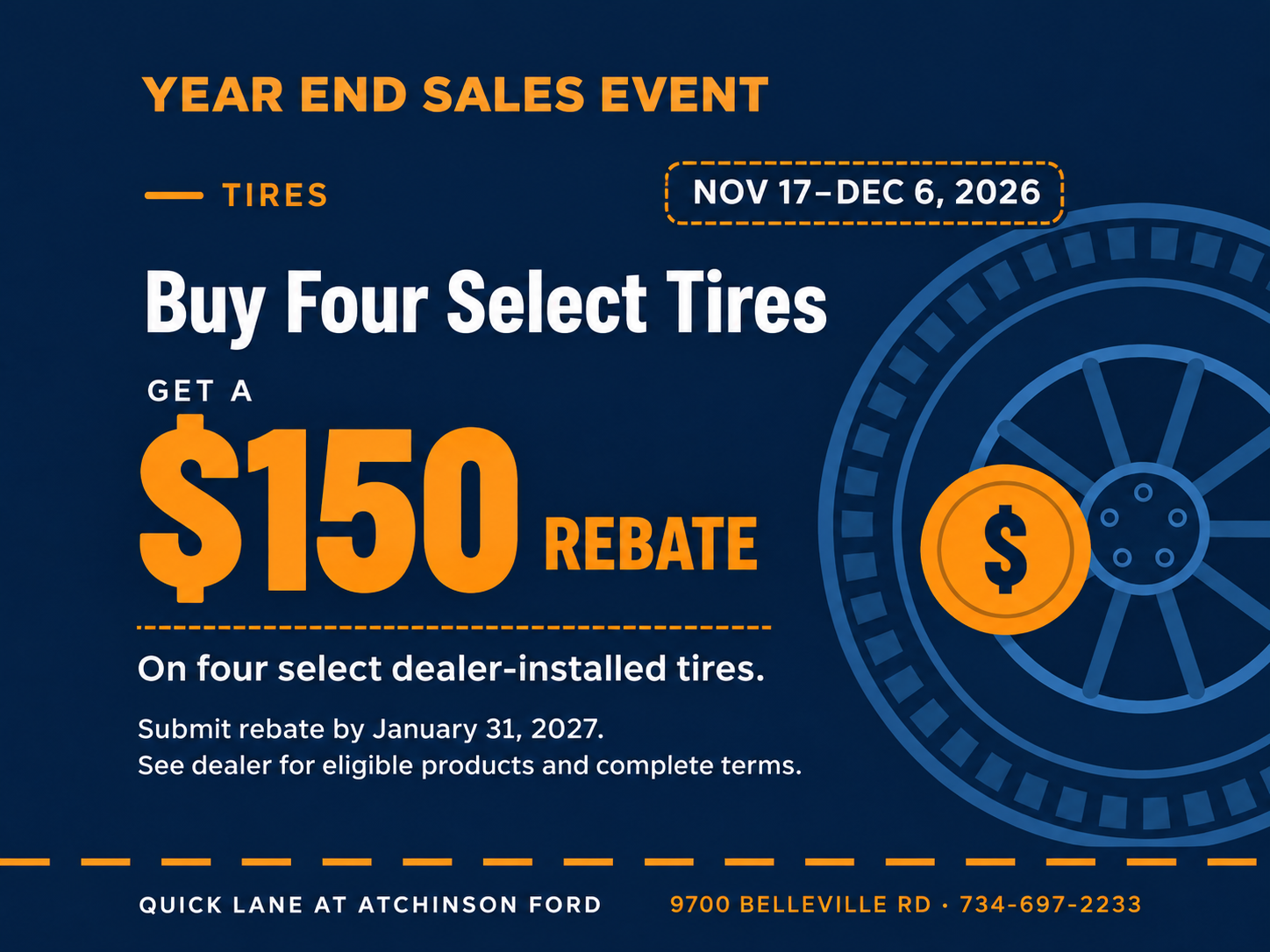
$150 rebate on four select dealer-installed tires at Quick Lane at Atchinson Ford in Belleville, MI, November 17 through December 6, 2026

Tires Before Winter: When to Replace Them, Why Tread Matters in Rain and Snow, and Good-Better-Best Options Near Canton, MI

Published November 20, 2026. Offers mentioned below are current as of this date; check the service coupons page for terms and expiration dates. Your tires are the only part of the vehicle that touches the road, and in a Michigan winter they are asked to do everything at once: grip in slush, drain standing water on Michigan Avenue, hold air through a 40-degree temperature swing, and survive the potholes that open up with every freeze and thaw. This guide covers when tires need replacing, why worn tread is a bigger problem in rain and snow than most drivers think, how we walk you through the good, better and best options at Quick Lane, and what good tires are worth in fuel economy and the life of the rest of your vehicle. Quick Lane at Atchinson Ford is in Belleville, about 10 minutes from the center of Canton, carries more than a dozen major brands, and services all makes and models. When do tires need to be replaced? Tread depth decides it, and the number most people know is the wrong one. The legal minimum in most states is 2/32 of an inch, but tires lose most of their wet and snow traction well before that. AAA's testing found that tires worn to 4/32" needed an extra 87 feet, about 43 percent more, to stop from highway speed on wet pavement compared with new tires. At the moment the new tires had stopped, the car on worn tires was still doing 40 mph. AAA's recommendation, and ours, is to plan replacement at 4/32"; if you rely on the tires in snow, start shopping at 6/32". The quarter test. Put a quarter upside down in a tread groove. If you can see the top of Washington's head, you are at or below 4/32" and it is time to shop. Age. Rubber hardens and cracks with time even if the tread looks fine. Most tire makers recommend replacement at ten years regardless of tread, and an inspection after six. The date code is the last four digits of the DOT number on the sidewall (week and year). Damage and uneven wear. Bulges, cuts, cords showing, or wear on one edge or in the center. Uneven wear usually means an alignment or pressure problem that should be fixed before new tires go on. Every oil change. The Works® package includes a tire rotation and pressure check, so tread depth gets measured at every visit without you asking. Why tires matter more once the weather turns Rain. Tread grooves exist to pump water out from under the tire. Half-worn tread moves half as much water, so the tire starts to hydroplane at a lower speed and stops later. In NHTSA's crash causation survey, tire and wheel problems were the single largest vehicle-related cause, about 35 percent of the crashes in which the vehicle itself was the critical reason. Snow and slush. Deep tread and sharp block edges are what bite into snow. By the time a tire is at 5/32", it has lost a large share of its snow traction even though it is still "legal." Cold. Below about 45 degrees, the rubber in a standard all-season tire stiffens and grips less, on dry pavement as well as wet. Winter tires and all-weather tires use compounds that stay flexible in the cold, which is why they stop shorter in January even on a clear road. Pressure. Tires lose about 1 psi for every 10-degree drop in temperature. A tire set in September can be 5 to 7 psi low by December, which is enough to wear the edges, hurt fuel economy and turn on the pressure light on the first cold morning. The pressure on the door-jamb label is the one to use, not the number on the sidewall. Potholes. Freeze-thaw season starts in late winter around here, and a tire with worn or stiff sidewalls is more likely to be damaged by a pothole, and more likely to take a wheel or an alignment with it. Why you should not wait Safety is the obvious one, and the AAA numbers above make the case better than we can. The rest is money. Fuel economy. Properly inflated tires improve gas mileage by 0.6 percent on average and up to 3 percent in some cases, and under-inflation costs about 0.2 percent for every 1 psi the average pressure drops, according to the U.S. Department of Energy. Many newer tires are also designed for lower rolling resistance, which is why the right replacement tire can pay part of its cost back at the pump. Alignment and suspension. Driving on tires that are worn unevenly, or on a vehicle that is out of alignment, scrubs tread off the new set too. An alignment check with new tires protects the purchase; it is the difference between 40,000 miles and 25,000 from the same tire. Brakes. Your brakes can only use the grip the tires give them. New pads on bald tires still stop late. Before winter, the two go together, which is why the brake inspection is part of the same visit. Resale. Tires are one of the first things an appraiser checks because they are one of the first things a buyer will have to replace. Matched, newer tires help a trade appraisal; a mismatched set with 3/32" hurts it. Good, better, best: how we walk you through the options Quick Lane carries more than a dozen major brands, and every tire we sell is covered by Ford's Low Price Tire Guarantee: find a better price on the same tire within 30 days of purchase and we will beat it. So the choice is about the tire, not about where to buy it. The advisor starts with your vehicle's size and load rating, how many miles a year you drive, and whether you will run one set year-round or switch to winter tires. From there, three tiers. Good: a quality all-season from a value brand Brands such as Cooper, Hankook, General and Falken make solid all-season tires that meet the vehicle's specifications at a lower price. For a commuter car that mostly sees plowed roads, or a vehicle you plan to trade in the next couple of years, this tier makes sense. Several of these brands are included in the current $150 rebate (see below). Better: a premium all-season or all-weather tire Goodyear, Bridgestone, Firestone, Pirelli, Yokohama, Toyo and Nitto lines in this tier typically bring longer treadwear warranties, better wet braking and quieter rides. The step worth asking about for Canton drivers is an all-weather tire: it carries the three-peak mountain snowflake symbol, meaning it meets a real snow-traction standard, but it stays on the vehicle all year. For a family vehicle that has to get to Plymouth-Canton schools on an unplowed morning without a second set of tires, this is often the best value. Best: the premium touring tire, or a dedicated winter set Michelin and BFGoodrich sit at the top of the range for treadwear, wet grip and ride, and they carry their own rebate right now ($80 rebate plus a $70 service allowance on a set of four, through December 6). The other "best" answer is a second set: dedicated winter tires on their own wheels from November to March, and your summer or all-season set the rest of the year. Each set lasts roughly twice as long, the winter tires stop shorter on snow and ice than any all-season can, and the swap twice a year is a quick visit. For a rear-wheel-drive Mustang or a vehicle that has to be out before the plows, it is the safest setup there is. Whichever tier you choose, we install, balance and check alignment, and the tire rotation in every Works package keeps the set wearing evenly from then on. What is on offer right now $150 rebate (or 32,000 Ford Rewards Points) on a set of four dealer-installed Goodyear, Cooper, Hankook, Bridgestone, Firestone, Toyo, Pirelli, Yokohama or Nitto tires, valid November 17 through December 6, 2026. $80 rebate plus a $70 service allowance (or 32,000 points) on a set of four Michelin or BFGoodrich tires, same dates. $80 instant discount for active and retired military and first responders on a set of four qualifying tires, through December 31, 2026 (Hero Code required). Low Price Tire Guarantee: find a better price within 30 days and we beat it, on more than a dozen brands. The Works® at $89.95 through December 31 includes the rotation and pressure check with the oil change and brake inspection. Service Now, Pay Later: a set of four at a bad time is what Quick Lane financing is for. Rebates are submitted at Ford.com/service-rebates or by mail; terms are on the service coupons page. How to get it done from Canton Call Quick Lane at 734-697-2233 or use the tire finder on our Quick Lane tires page with your year, make, model and trim. Tell us how you drive and whether you want one set or two. We quote installed prices across the tiers and apply the current rebate or the price guarantee. Quick Lane is at 9700 Belleville Road, Belleville, next to the dealership, about 10 minutes from the center of Canton: down Canton Center Road, which becomes Belleville Road at Michigan Avenue, or I-275 to the Ecorse Road exit. Most sets are installed the same day if the tire is in stock; call ahead for special orders. The tires near Canton page has the FAQ, and our tire care advice page covers rotation, pressure and the quarter test in more detail. Questions we hear every November Do I really need winter tires in Canton? Not necessarily. A good all-weather or all-season tire with plenty of tread handles plowed roads. Winter tires are the right call if you must drive before the plows, drive a rear-wheel-drive vehicle, or want the shortest stopping distances on ice. All-wheel drive helps you go; it does not help you stop. Tires do. Should I replace two tires or four? Four is best, and on all-wheel-drive vehicles it is usually required so the tire diameters match. If you replace two, the new ones go on the rear for stability in the wet, regardless of which wheels drive. Can I get the rebate and the price guarantee? Usually, yes: the price guarantee is applied at the counter and the rebate is submitted to Ford afterward. Ask the advisor to show you the math on the quote before you decide. How long does it take? A set of four is usually about an hour once the tires are in hand. Call ahead for a current time. Do you install tires on non-Ford vehicles? Yes. Quick Lane services all makes and models, and the brands above cover nearly every size on the road. What else should I check before the first snow? Brakes and oil. Our posts on brakes before winter and oil changes before winter cover both, and all three can be done in one visit. Tire rebate: dealer-installed purchases only; limit one tire rebate per retail vehicle (15 per fleet); $150 rebate or 32,000 Ford Rewards Points on a set of four Goodyear®, Cooper®, Hankook, Bridgestone, Firestone, Toyo® (excludes medium and commercial/Motorsport), Pirelli, Yokohama® and Nitto®; $80 rebate and $70 service allowance or 32,000 Ford Rewards Points on a set of four Michelin and BFGoodrich®; valid 11/17/26 to 12/6/26; submit by 1/31/27 at Ford.com/service-rebates or by mail; Ford Rewards membership required within 60 days of service invoice date to receive points. Military and First Responder tire discount: available to active and retired military and first responders; $80 instant discount on a set of four qualifying tires from participating brands; dealer-installed purchases only; present nontransferable Hero Code at purchase (requires ID.me validation); limit two Hero Codes per calendar year per customer; valid for tires purchased and installed 1/1/26 to 12/31/26. Low Price Tire Guarantee: dealer-installed retail/fleet purchases only; must present competitor's current ad for the exact tire within 30 days of purchase; online quotes must be for new tires from direct retailer sites (excludes marketplaces/third-party resellers). Ford may change or discontinue these programs at any time. See participating U.S. dealer for details. Quick Lane® and The Works® are registered trademarks of Ford Motor Company. Stopping-distance figures: AAA, "Tread Lightly: Worn Tires Put Drivers at Risk" (2018). Crash statistic: NHTSA, DOT HS 812 506. Fuel economy figures: U.S. Department of Energy, fueleconomy.gov.
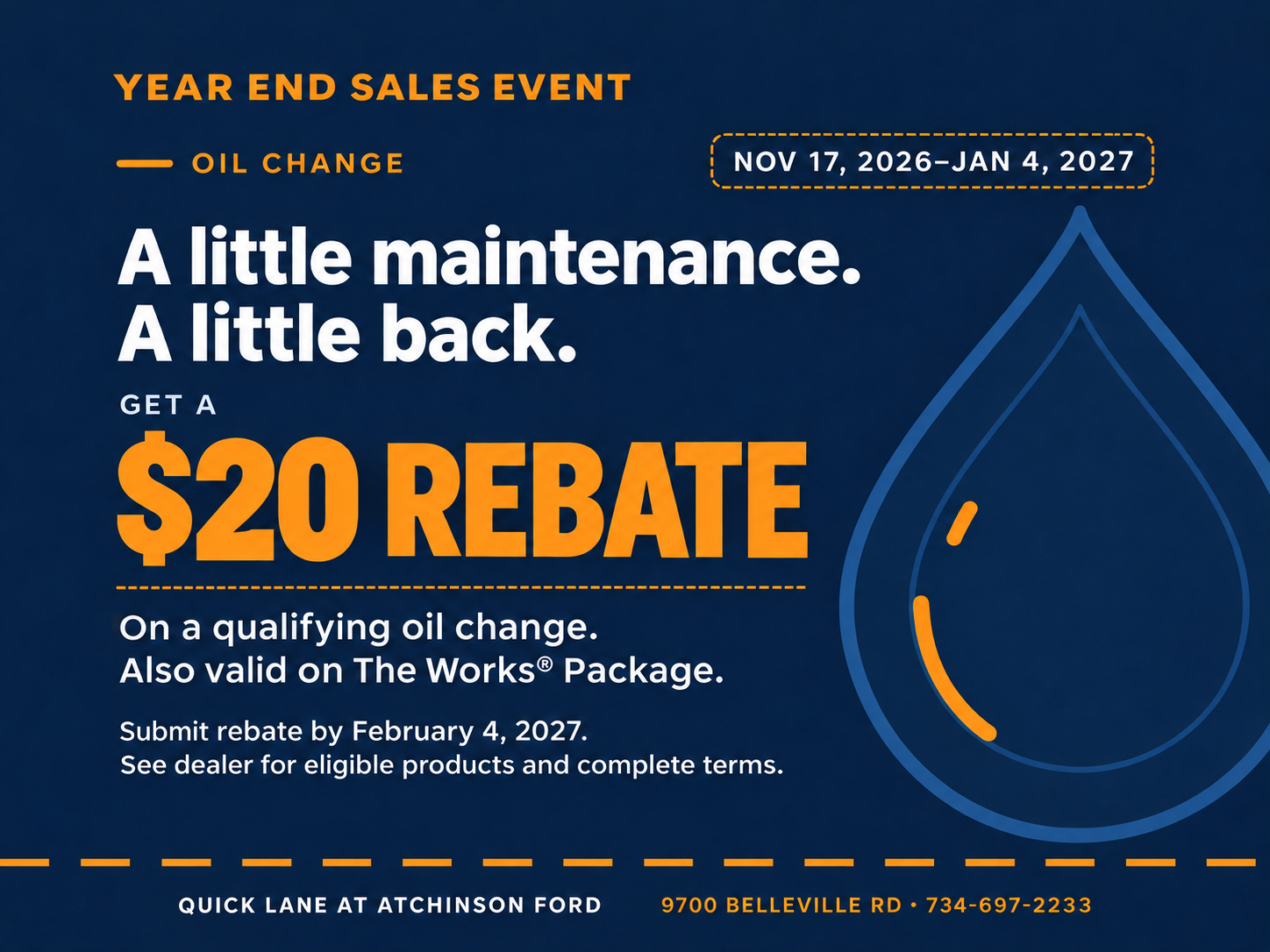
$20 rebate on a qualifying oil change, including The Works package, at Quick Lane at Atchinson Ford in Belleville, MI, through January 4, 2027

Oil Change Before Winter: When It's Due, Why Cold Weather Changes the Math, and Motorcraft Oil Options Near Canton, MI

Published November 20, 2026. Offers mentioned below are current as of this date; check the service coupons page for terms and expiration dates. An oil change is the cheapest thing you will do for your engine all year, and the one that does the most for it. It also happens to be the easiest way to get a full look at the vehicle before winter, because The Works® package bundles a tire rotation, brake inspection and battery test into the same visit. This guide covers when your oil is actually due, why the interval matters more in cold weather, how Ford's Motorcraft® oils stack up from good to better to best, and what it is worth to you in fuel economy, repair bills and resale. Quick Lane at Atchinson Ford is in Belleville, about 10 minutes from the center of Canton, and services all makes and models. When is my oil change due? The old 3,000-mile rule is gone. Modern oils and engines go much further, and most Fords built since 2008 have Ford's Intelligent Oil-Life Monitor®, which calculates the interval from how you actually drive rather than from a fixed number. On most of those vehicles the limit under normal driving is 10,000 miles or one year, whichever comes first, and the monitor shortens it when it sees short trips, idling, towing, dusty roads or extreme temperatures. The right answer for your vehicle is in three places: The oil-life reminder in the instrument cluster or the FordPass® app. Do not wait for 0 percent; when it says 15 to 20 percent, book the visit. Your owner's manual or Ford's online maintenance schedule, which also lists the oil specification and capacity. The calendar. Oil degrades with time, not just miles. If it has been a year, it is due even if the mileage is low. Low-mileage drivers are exactly the ones the one-year rule is for. If you drive something other than a Ford, the same logic applies: follow the manufacturer's interval for your oil type and driving conditions, and tell the advisor how you drive. Short trips around Canton count as severe service in the manual, not normal service. Why the interval matters more in winter Cold starts are where engines wear. Most engine wear happens in the first minute after a cold start, before the oil has fully circulated. Oil thickens as the temperature drops, so the colder the morning, the longer that minute takes. Fresh oil of the correct grade flows fastest; old oil that has thickened with contaminants flows slowest. Short trips never cook off the moisture. A cold engine produces condensation and lets a little unburned fuel past the rings. On a long drive the oil reaches full temperature and boils that off. On a January week of five-minute trips to the school and the store, it never does, and the oil picks up water and fuel that reduce its ability to protect. This is why the oil-life monitor shortens the interval in winter even if your mileage did not change. The rest of the vehicle is under stress too. Batteries lose cranking power in the cold, wiper blades harden, coolant and washer fluid need to be rated for the temperature, and tire pressures drop about 1 psi for every 10-degree fall in temperature. An oil change visit is when all of that gets checked. Why you should not stretch it Engine life. Oil lubricates, cools, cleans and seals. As it ages, additives deplete, it thickens, and it stops suspending the soot and metal it picked up. Sludge and varnish are the result, and on modern turbocharged engines with tight tolerances and variable valve timing, that shows up as noise, rough running and expensive repairs. There is no cheaper insurance for an engine than oil changed on time. Fuel economy. The U.S. Department of Energy puts it plainly: using the manufacturer's recommended grade of motor oil improves gas mileage by 1 to 2 percent. Thick, worn-out oil costs you a little at every fill-up; the wrong grade costs you more. Warranty. Ford's powertrain coverage expects the maintenance in the owner's manual to be done on schedule. Service records from a Ford dealer or Quick Lane are the easiest way to show that if a warranty question ever comes up. Resale and trade-in value. An appraiser cannot see inside the engine, so the service history stands in for it. A vehicle with regular oil changes on file appraises more confidently than one with no record at all. If a trade is in the plan, keep the receipts; we can pull our own records when you come in for a trade estimate. Catching the next problem early. The vehicle checkup in The Works is where we find the worn belt, the weak battery and the tire that is wearing on one edge. Those are inexpensive now and expensive on the shoulder of I-275 in February. Good, better, best: Motorcraft® oil options Ford publishes an oil specification for every engine, and Motorcraft is the oil Ford builds and tests to it. The advisor will look up your spec and capacity; from there, these are the choices. Good: Motorcraft® Synthetic Blend Ford's standard oil for most gasoline engines and what comes in The Works package at $89.95 (through December 31, 2026). It meets the Ford specification for the engines it is recommended for, flows well in the cold, and is changed on the interval the oil-life monitor sets. For a normally driven Escape, Explorer, F-150 or Fusion, this is the right oil and there is no reason to pay for more. Better: Motorcraft® Full Synthetic Full synthetic oil is more stable at both ends of the thermometer: it flows more easily on a 5-degree morning and resists breaking down under heat better than a blend. Ford specifies full synthetic for a number of its EcoBoost® engines, and it is the better choice if you tow, idle a lot, make mostly short trips, or simply want the most protection between changes. If your Ford calls for it, it is not an upgrade, it is the requirement; the advisor will tell you which. Best: The Works® with the oil your engine was built for The best oil change is the one that comes with the inspection. The Works package pairs the correct Motorcraft oil (synthetic blend or full synthetic) and a Motorcraft oil filter with a tire rotation and pressure check, brake inspection, multi-point vehicle checkup, fluid top-off, battery test, filter check and a belts-and-hoses check. Before winter, that is the visit that finds the pads at 3 millimeters and the battery that will not start on the first below-zero morning. Super Duty® diesel owners have their own tier here: Motorcraft Super Duty diesel oil and filter, and a package built for the Power Stroke®. Whichever oil you choose, the filter should be a Motorcraft filter matched to the engine. A cheap filter with the right oil is still a cheap filter. What is on offer right now The Works® Synthetic Blend Oil Change package starts at $89.95 through December 31, 2026, including up to six quarts of Motorcraft oil and a Motorcraft filter, tire rotation and pressure check, brake inspection, vehicle checkup, fluid top-off, battery test, filter check and belts-and-hoses check (hybrid battery test excluded). $20 rebate or 5,000 Ford Rewards Points on an oil change, including The Works, valid November 17, 2026 through January 4, 2027; submit by February 4, 2027. Free battery test, and if it fails, Motorcraft Tested Tough® PLUS batteries at $149.95 MSRP and Tested Tough MAX from $199.95 MSRP through December 31. Complimentary brake inspection through December 31 if you want the brakes looked at outside of a Works visit. Ford Mobile Service: for routine maintenance we can come to your home or office in Canton; call 734-706-1892 for availability. Terms are on the service coupons page and the Quick Lane specials page. How to get it done from Canton Book online or call Quick Lane at 734-697-2233 with the year, make, model and mileage. Mention how you drive (short trips, towing, highway) so we can confirm the oil. Quick Lane is at 9700 Belleville Road, Belleville, next to the dealership: down Canton Center Road, which becomes Belleville Road at Michigan Avenue, about 10 minutes from the center of Canton. From I-275, use the Ecorse Road exit. No appointment is required, but calling ahead gets you a realistic wait. Ask for The Works if a rotation and inspection are due, and ask the advisor to reset the oil-life monitor before you leave. The oil change near Canton page has the FAQ, our oil types guide goes deeper on blends versus synthetics, and the oil change advice page covers the basics. The full menu is on the Quick Lane oil change page. Questions we hear every November Can I switch from synthetic blend to full synthetic? Yes, as long as the oil meets your engine's Ford specification. You do not need to flush anything; the advisor simply drains the old oil and fills with the new. Is full synthetic worth it if the manual says blend is fine? If you make mostly short trips, tow, or keep vehicles a long time, many drivers think so. If you drive normally and change on schedule, the blend meets the spec and protects the engine. Both are honest answers; it depends on how you use the vehicle. How long does it take? The Works is usually done while you wait. Call ahead and we will tell you the current wait before you leave Canton. Do you change oil on non-Ford vehicles? Yes. Quick Lane services all makes and models with the oil grade the manufacturer specifies. What else should I check before the first snow? Battery (free test), wiper blades, washer fluid rated for below-zero temperatures, tire tread and pressure, and brakes. Our posts on brakes before winter and tires before winter cover the other two in detail. The Works® package includes up to six quarts of Motorcraft® oil and Motorcraft oil filter; excludes hybrid battery test; see Service Advisor for details. $20 rebate or 5,000 Ford Rewards Points: limit one per vehicle; not valid on prior purchases; valid 11/17/26 to 1/4/27; submit by 2/4/27 at Ford.com/service-rebates or by mail; Ford Rewards membership required within 60 days of service invoice date to receive points. Battery offers per coupon terms. Ford Mobile Service offered by participating dealers; may be limited by availability, distance or other dealer criteria; excludes parts and repair charges. Ford may change or discontinue these programs at any time. Quick Lane®, Motorcraft®, The Works®, EcoBoost®, Super Duty®, Power Stroke®, Tested Tough® and FordPass® are trademarks of Ford Motor Company. Fuel economy figure: U.S. Department of Energy, fueleconomy.gov.
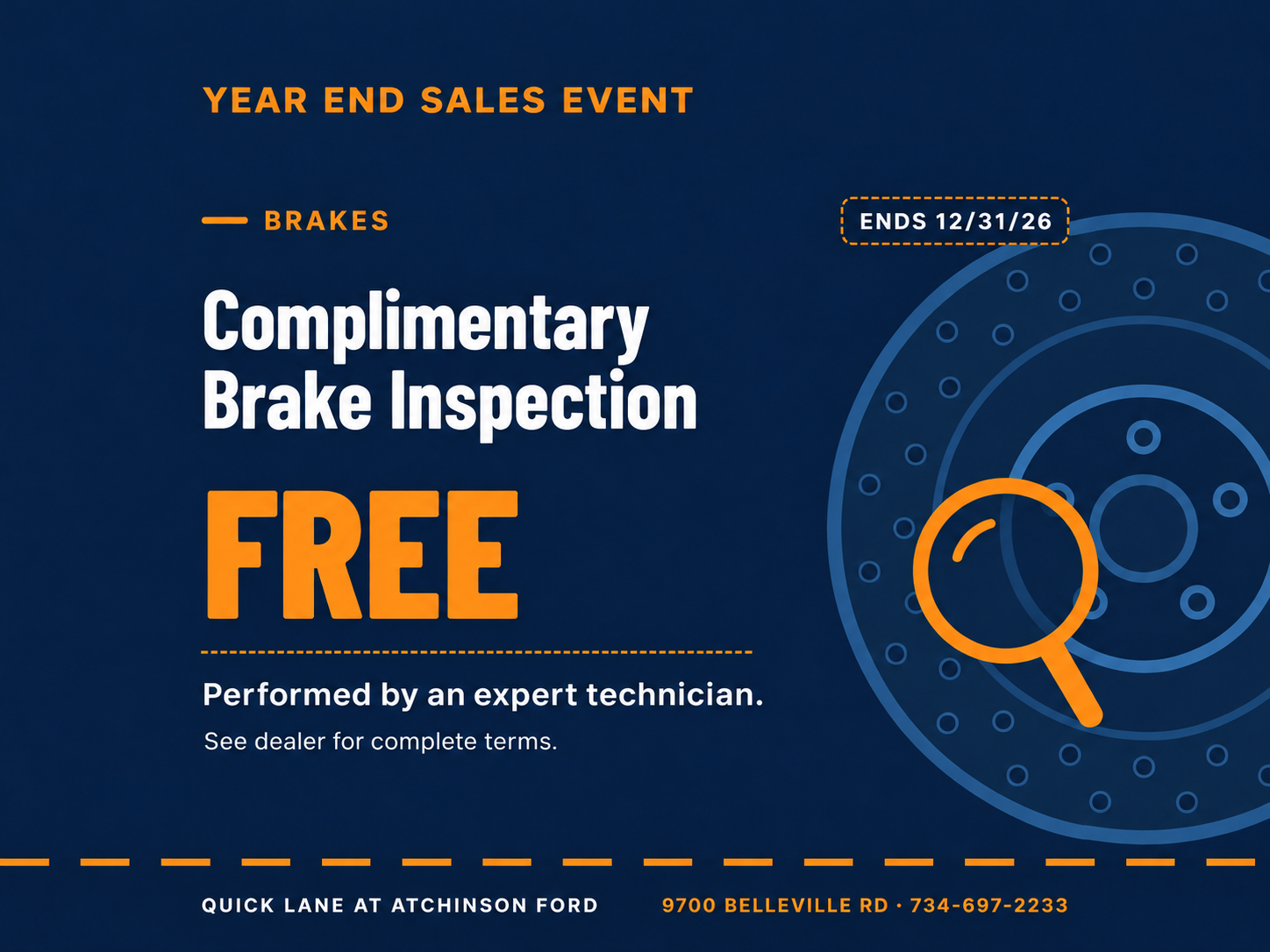
Complimentary brake inspection at Quick Lane at Atchinson Ford in Belleville, MI, through December 31, 2026

Brake Service Before Winter: When to Replace Brakes, Why It Matters in Rain and Snow, and Your Motorcraft Options Near Canton, MI

Published November 20, 2026. Offers mentioned below are current as of this date; check the service coupons page for terms and expiration dates. The first real snow in Canton usually shows up in the next few weeks, and the stretch between now and then is the best time of year to find out what shape your brakes are in. Pads and rotors that feel fine on dry pavement in October get asked to do a lot more on a slushy Ford Road in December. This guide covers when brakes need attention, why waiting costs more, what changes about braking in rain and snow, and how we walk you through Ford's Motorcraft® and Omnicraft™ options at Quick Lane at Atchinson Ford in Belleville, about 10 minutes from the center of Canton. When do brakes need to be done? There is no single mileage for brake pads. On the same vehicle, a highway commuter might see 60,000 miles from a set and a stop-and-go driver might see 25,000. What matters is the measurement, so the honest answer is: have them measured, then plan from the number. Every oil change. The Works® package includes a brake inspection with the oil change and tire rotation, which is why most of our customers never get surprised by their brakes. The technician measures pad thickness and looks at the rotors while the wheels are already off for the rotation. Before winter and before a long trip. Even if the last inspection was recent, a quick check before the weather turns is cheap insurance; through December 31, 2026 the brake inspection at Quick Lane is complimentary. Any time you notice a change. Noise, a different pedal feel, a pull or a warning light should be checked right away rather than at the next scheduled visit. As a rule of thumb, pads are usually recommended for replacement around 3 millimeters of friction material, and many shops will flag them at 4 millimeters so you can plan the visit instead of being forced into it. Rotors have a minimum thickness stamped on them; once they are at or below it, they have to be replaced rather than resurfaced. The warning signs Squealing when you brake. Most pads have a wear indicator that makes a high-pitched squeal when the material is nearly gone. It is designed to be annoying. Grinding. Metal-on-metal. The pad backing plate is now cutting into the rotor, and what would have been a pad job is turning into a pad-and-rotor job. A pulsing pedal or a shake in the steering wheel while braking. Usually uneven rotor wear or rotor thickness variation. Pulling to one side. Often a sticking caliper or a collapsed brake hose, both common on vehicles that spend winters in road salt. A soft, low or spongy pedal. Air or moisture in the brake fluid, or a leak. This one is urgent. A brake or ABS warning light, or a burning smell after driving. If you can tell us when it happens (cold mornings, highway speeds, light braking, hard braking), the diagnosis goes faster. Why you should not wait Safety first. In NHTSA's National Motor Vehicle Crash Causation Survey, brake-related problems accounted for about 22 percent of the crashes where the vehicle itself was the critical reason. Brakes that are worn, glazed or uneven do not fail all at once; they just stop a little later and a little less evenly each month, until the day you need every foot. It costs less early. A set of pads replaced on time is the least expensive brake job there is. Pads that are run to the backing plate take the rotors with them, and a seized caliper from a neglected winter can add a caliper and a hose. The complimentary inspection is how you stay on the inexpensive side of that line. Fuel economy and tire life. A caliper that does not fully release drags the pad on the rotor all the time. You pay for that in fuel, in heat, and in a tire that wears faster on one corner. It is a common finding on vehicles that have been through a few salty winters. Resale and trade-in value. A documented brake service in the history is one of the first things an appraiser looks for, because it is one of the first things a buyer will notice on a test drive. If you are thinking about a trade this winter or next spring, the service record helps. Why brakes matter more once the weather turns Dry pavement forgives a lot. A tired set of brakes can feel acceptable in September because the tires have plenty of grip to work with and stopping distances are short. Rain and snow take that margin away. Rain. Wet roads lengthen stopping distances, and the first rain after a dry spell lifts oil off the pavement. Brakes that pull or pulse are hard to modulate on a wet surface, which is exactly when smooth, even braking matters most. Snow and ice. On a slick surface, your anti-lock brakes are doing dozens of tiny applications per second. They need even pad contact, healthy rotors and clean fluid to do that well. A caliper that sticks or a rotor that is warped makes ABS work harder and stop later. Cold. Brake fluid absorbs moisture over time. In cold weather that moisture can affect pedal feel, and under hard braking it lowers the fluid's boiling point. Ford publishes a brake fluid service interval for each model; the advisor can look yours up. Salt. Michigan road salt is hard on rotors, caliper slide pins and brake lines. Surface rust on a rotor after a wet night is normal and wipes off in the first few stops; pitting, grooves and a lip at the edge of the rotor are not. Canton driving is a mix of stop-and-go on Ford Road and Michigan Avenue and highway miles on I-275 and M-14. That combination heats brakes up and cools them down constantly, which is why a pre-winter inspection is worth more here than in a place with one kind of driving. Good, better, best: the brake options we walk you through Every brake job at Quick Lane starts the same way: the technician measures the pads and rotors, checks the calipers, hoses and parking brake, and gives you the findings and an estimate before any work is done. From there, you choose the parts. Here is how we explain the choices. Good: Omnicraft™ brake pads Omnicraft is Ford's parts line for all makes and models, so it is often the right call if you drive something other than a Ford, or if you want a quality part at a lower price point. Omnicraft pads come in ceramic and semi-metallic formulations and are backed by a warranty of at least two years that covers parts and labor. Quick Lane services all makes, so this is the option that keeps a Honda, Chevy or Toyota in the family on the same schedule as the Ford. Better: Motorcraft® brake pads Motorcraft is Ford's own service brand, engineered for Ford and Lincoln vehicles. Motorcraft pads are built to match the original equipment design and friction material, with chamfered and slotted pads to reduce noise and heat, and the insulators, shims and hardware in the box so the job is done right the first time. They carry Ford's two-year, unlimited-mile Motorcraft warranty, which includes labor. And when a Ford dealer or Quick Lane technician installs them, they qualify for Ford's Lifetime Brake Pad Guarantee: replacement pads for as long as you own the vehicle (pads only; labor and any other brake service are extra, and you need your original repair order). For most Ford owners this is the sweet spot. Best: Motorcraft® pads with Motorcraft coated rotors If the inspection shows the rotors are at or near their minimum, or they are grooved, pitted or warped, the best long-term job is pads and rotors together. Motorcraft coated rotors use a high-carbon casting that resists heat cracking and brake fade, are mill-balanced for vibration-free stops, and have an anti-corrosive coating on the hat and vents. That coating matters in Michigan: it keeps the vents from rusting shut and keeps the rotor from corroding onto the hub. New pads bedded onto new, true rotors is the quietest and smoothest brake job we can do, and it resets the clock on everything. (Mustang, Bronco and Raptor owners who want more than stock can also ask about Ford Performance brake components.) Whichever tier you pick, the inspection is free through December 31, 2026, and all Motorcraft and Ford parts installed here are covered for two years with unlimited mileage, including labor. What is on offer right now Complimentary Brake Inspection through December 31, 2026: friction material, caliper operation, rotors, drums, hoses, connections and parking brake. Lifetime Brake Pad Guarantee on Motorcraft pads installed by a Ford dealer or Quick Lane technician. The Works® synthetic blend oil change package starts at $89.95 through December 31 and includes a brake inspection and tire rotation, plus Ford's $20 rebate or 5,000 Ford Rewards Points on the oil change through January 4, 2027. Ford Rewards. Brake service earns points you can put toward the next visit. Service Now, Pay Later. If a pad-and-rotor job lands at a bad time, ask about Quick Lane financing. Full terms are on the service coupons page and the Quick Lane specials page. How to get it done from Canton Book online or call Quick Lane at 734-697-2233. Tell us the year, make, model and mileage and what you have noticed. Drive down Canton Center Road; it becomes Belleville Road at Michigan Avenue. Quick Lane is at 9700 Belleville Road, next to the dealership, about 10 minutes from the center of Canton. From I-275, use the Ecorse Road exit. Get the inspection results and an estimate, choose the parts, and we do the work. Pair it with The Works if an oil change is due so the rotation and inspection happen in one visit. Our brake service near Canton page has the details and the FAQ, our brake service advice page explains what the common noises mean, and the Quick Lane brakes page covers the full menu. For a Ford warning light or a complex repair, the main Atchinson Ford Service Center is at 9800 Belleville Road. Questions we hear every November How long does a brake job take? An inspection is usually done while you wait. Pads on one axle are typically a same-day job; pads and rotors on both axles depend on parts availability. Call ahead and we will give you a realistic time. Do I need new rotors with new pads? Not always. Rotors are measured during the inspection. If they are above minimum thickness and smooth, they can stay; if they are scored, warped or below minimum, they should be resurfaced or replaced with the pads. Should I do brakes or tires first before winter? Both matter, and they work together: your tires provide the grip and your brakes use it. If you can only do one right now, let the inspection decide; a set of pads at 2 millimeters is more urgent than tires at 5/32", and the reverse is also true. Our tires near Canton page covers the current $150 rebate, which runs through December 6. Is the lifetime guarantee really lifetime? Yes, for as long as you own the vehicle, on Motorcraft pads installed by a Ford dealer, Lincoln dealer or Quick Lane technician. It covers the pads only; labor and any other brake service, such as rotors, are extra, and it requires the original repair order. Commercial, police, taxi and similar vehicles are excluded. You service non-Ford vehicles? Yes. Quick Lane services all makes and models, and Omnicraft parts are made for exactly that. Complimentary Brake Inspection and Lifetime Brake Pad Guarantee per the coupon terms; see participating dealer for details. Lifetime Brake Pad Guarantee available for Motorcraft® brake pads purchased after 7/1/14; nontransferable; requires copy of original repair order and completion of any necessary brake service (e.g., rotor service); pads must be installed by a U.S. Ford Dealer, Lincoln Dealer or Quick Lane® technician; covers pads only, labor costs excluded; commercial, taxi, limousine, postal, police, tow, racing and emergency vehicles excluded. Motorcraft® and Ford Parts warranty: two years, unlimited mileage, includes limited labor; see dealer for a copy of the limited warranty. The Works® package includes up to six quarts of Motorcraft® oil and Motorcraft oil filter; excludes hybrid battery test. Ford may change or discontinue these programs at any time. Quick Lane®, Motorcraft®, Omnicraft™ and The Works® are trademarks of Ford Motor Company. Crash statistic: NHTSA, Critical Reasons for Crashes Investigated in the National Motor Vehicle Crash Causation Survey (DOT HS 812 506).

Contact Us

Fill out this form below and we'll contact you shortly
*Required Fields